
Bravodent Blog • Keeping Your Teeth
Short answer: Often yes, at least for some teeth. Whether a tooth can be kept depends on the bone and gum support around it, how loose it is, the condition of the root and the root canal, and how predictable it is over the long term. All-on-4 and All-on-6 are planned when the remaining teeth in a jaw cannot be kept for the long term. If some teeth can be saved, gum treatment, root canal treatment, a crown or bridge, or single implants are considered together.
|
Medically reviewed: Dr. Ümit Sait Yavuz, DDS, PhD • Periodontist, Bravodent Kadıköy Last updated: November 2026. This content is for information only. It does not diagnose and does not replace an examination. |
|
Quick guide
|
"I do not want to lose my own teeth": the sentence we hear most
Most people who come to us for All-on-4, All-on-6, or implant treatment say the same thing at the first visit: "If it is possible, I want to keep my own teeth."
That is a very natural wish. In a patient survey in Canada, a large majority said they would rather keep a tooth that could be treated than have it extracted. The share was about 97% for front teeth and about 90% for back teeth (Azarpazhooh et al., 2013).
This article explains how we decide which teeth can be kept, why teeth are removed in All-on-4 and All-on-6, and which options exist if you want to keep your teeth.
Why keeping your own tooth is valuable
- A natural feel: A natural tooth senses and cushions chewing force through the ligament around the root (the periodontal ligament). An implant does not have this ligament.
- Bone and gum: A tooth that is kept also helps preserve the bone and gum around it.
- The feeling of "my own tooth": For many people, keeping their own tooth matters psychologically as well.
Keeping a tooth makes sense only when that tooth can be placed on a healthy foundation and can function over the long term. Ongoing bleeding when you brush can be an early sign that this foundation is breaking down.
Why teeth are removed in All-on-4 and All-on-6
All-on-4 and All-on-6 replace all the teeth in one jaw with a fixed bridge on 4 or 6 implants. The difference between the two is explained in our All-on-4 and All-on-6 comparison. These treatments are usually planned when:
- The jaw has no teeth left
- Most of the remaining teeth cannot be kept long term because of advanced gum disease, deep decay, or fractures
A natural tooth and an implant are usually not joined in the same full-arch bridge. A natural tooth moves slightly because of its ligament, while an implant is fixed in the bone. A weak tooth left between the bridge can also become infected later and affect the whole plan. That is why, in a jaw planned for All-on-4 or All-on-6, teeth that cannot be kept are removed.
The important point is this: All-on-4 and All-on-6 are not the only option. If some of your teeth are healthy, a different plan that keeps them may be more suitable.
Which teeth can be saved? How is the decision made?
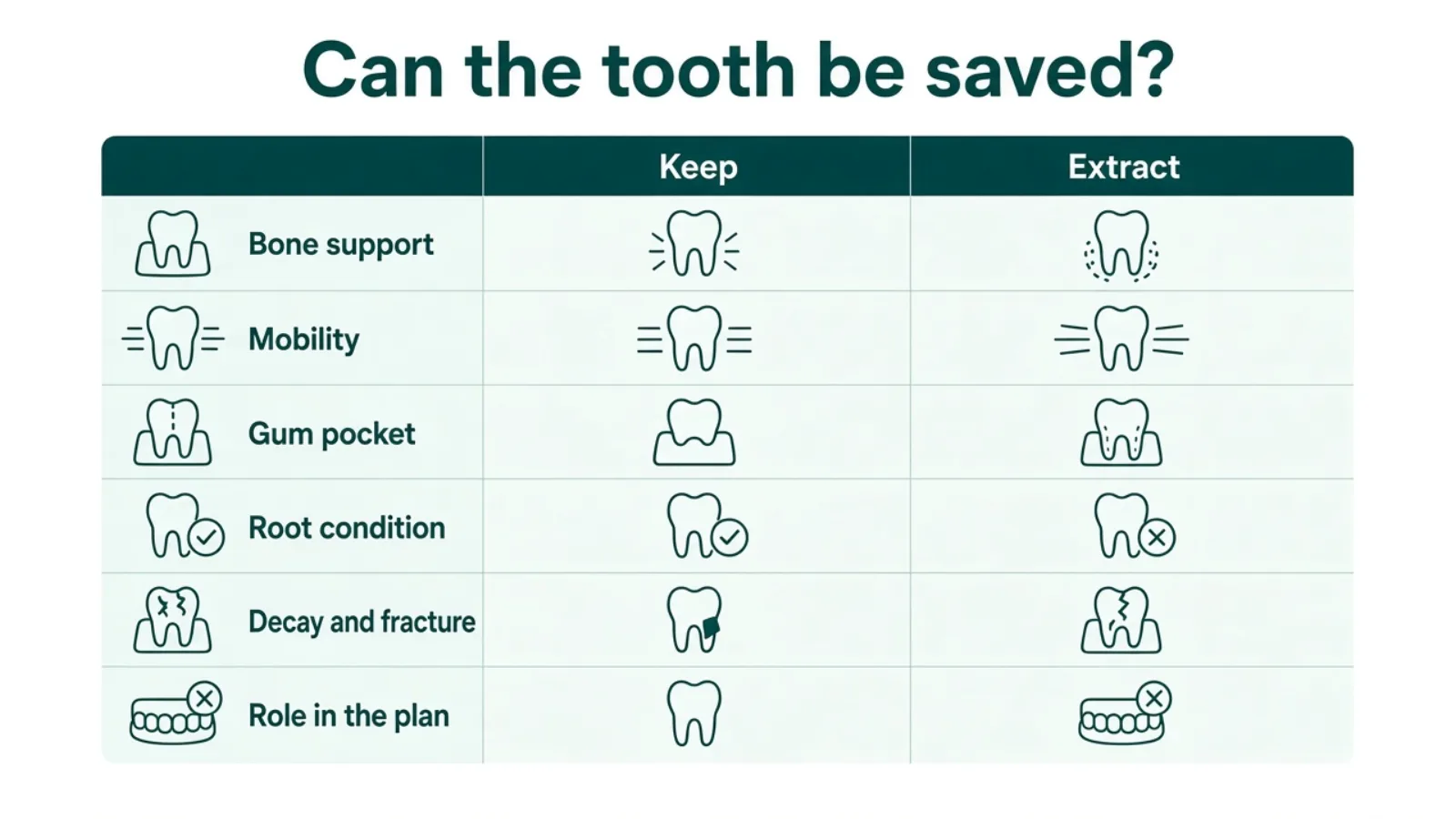
Each tooth is assessed on its own. This assessment is called the prognosis: a view of the tooth's future. The main criteria are:
| Criterion | In favour of keeping | In favour of extraction |
| Bone support | A substantial part of the root is still in bone | Bone loss close to the root tip |
| Mobility | Mild, or likely to lessen with treatment | Severe; the tooth has drifted |
| Gum pocket and inflammation | Can be brought under control with treatment | Repeated abscess; a deep pocket that does not respond |
| Root and canal | A root canal treatment or retreatment is possible | Vertical root fracture; advanced root resorption |
| Decay and fracture | Can be repaired with a filling or a crown | The damage extends well below the gum |
| Place in the plan | It will function in chewing and in the prosthetic plan | Its position puts the rest of the plan at risk |
Smoking, diabetes that is not under control, and daily oral care also affect the decision.
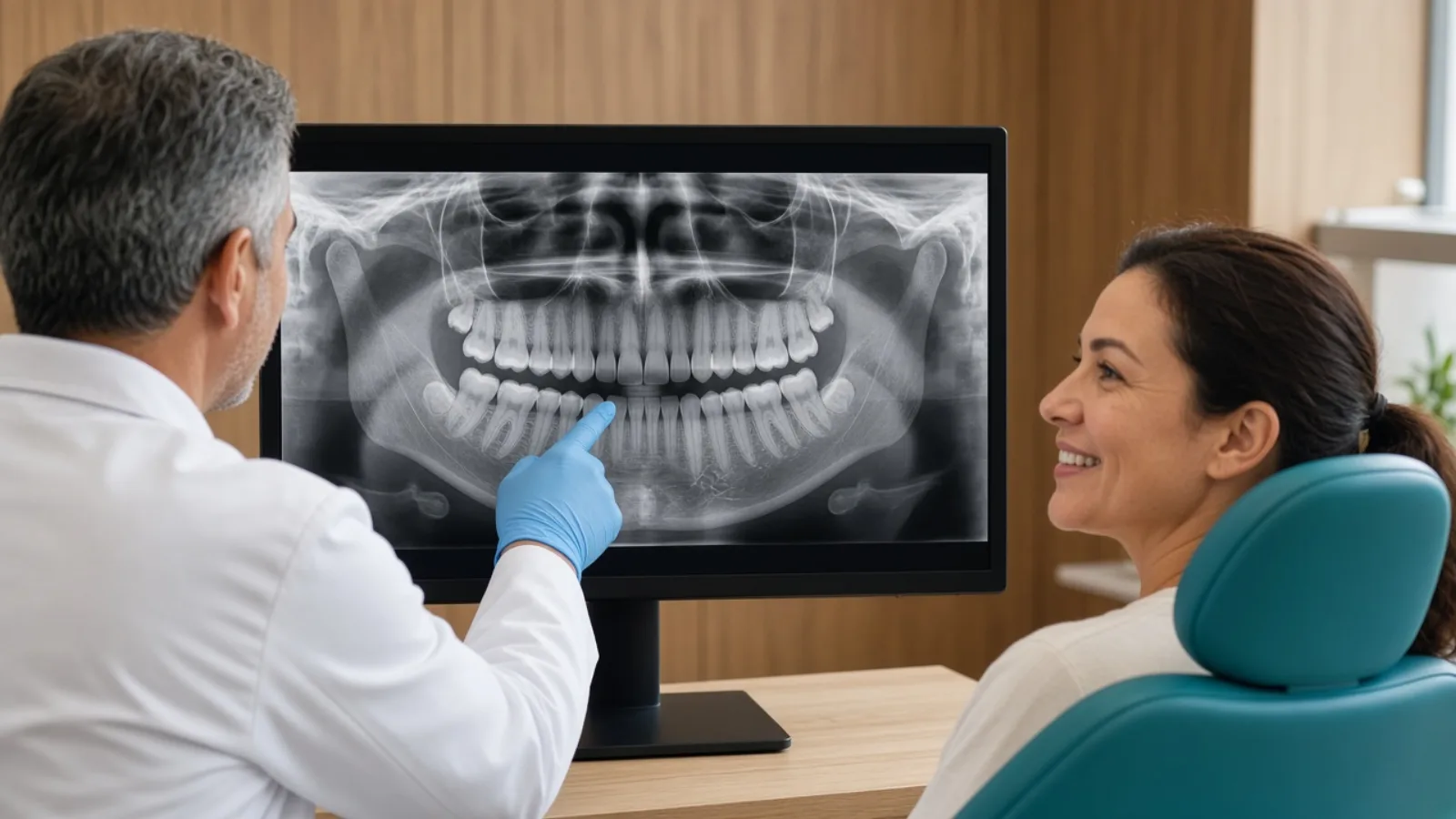
A panoramic X-ray alone may not be enough for a sound decision. A 3D scan (CBCT) and gum-pocket measurements show the condition of the teeth much more clearly.
Which options can keep your teeth?
1. Gum (periodontal) treatment
In gum disease the aim is to bring inflammation under control and return the tissues that hold the teeth to health. Deep cleaning (root surface debridement) is used, and when needed surgery and treatments that rebuild tissue (regenerative treatment).
For advanced gum disease, the European Federation of Periodontology (EFP) recommends an interdisciplinary approach after gum treatment: orthodontics, splinting teeth together, adjusting the bite, and tooth- or implant-supported prostheses (Herrera et al., 2022). The approach at Bravodent is described on the gum disease treatment page.
2. Root canal treatment and retreatment
An inflamed tooth, or a tooth that already had a root canal and is causing trouble again, can often be kept with root canal treatment or retreatment. What the procedure involves is on our root canal treatment page.
3. Filling, crown, and bridge
A tooth that has lost substance from decay or a fracture can, when the situation allows, be strengthened with a filling or a crown and made functional again.
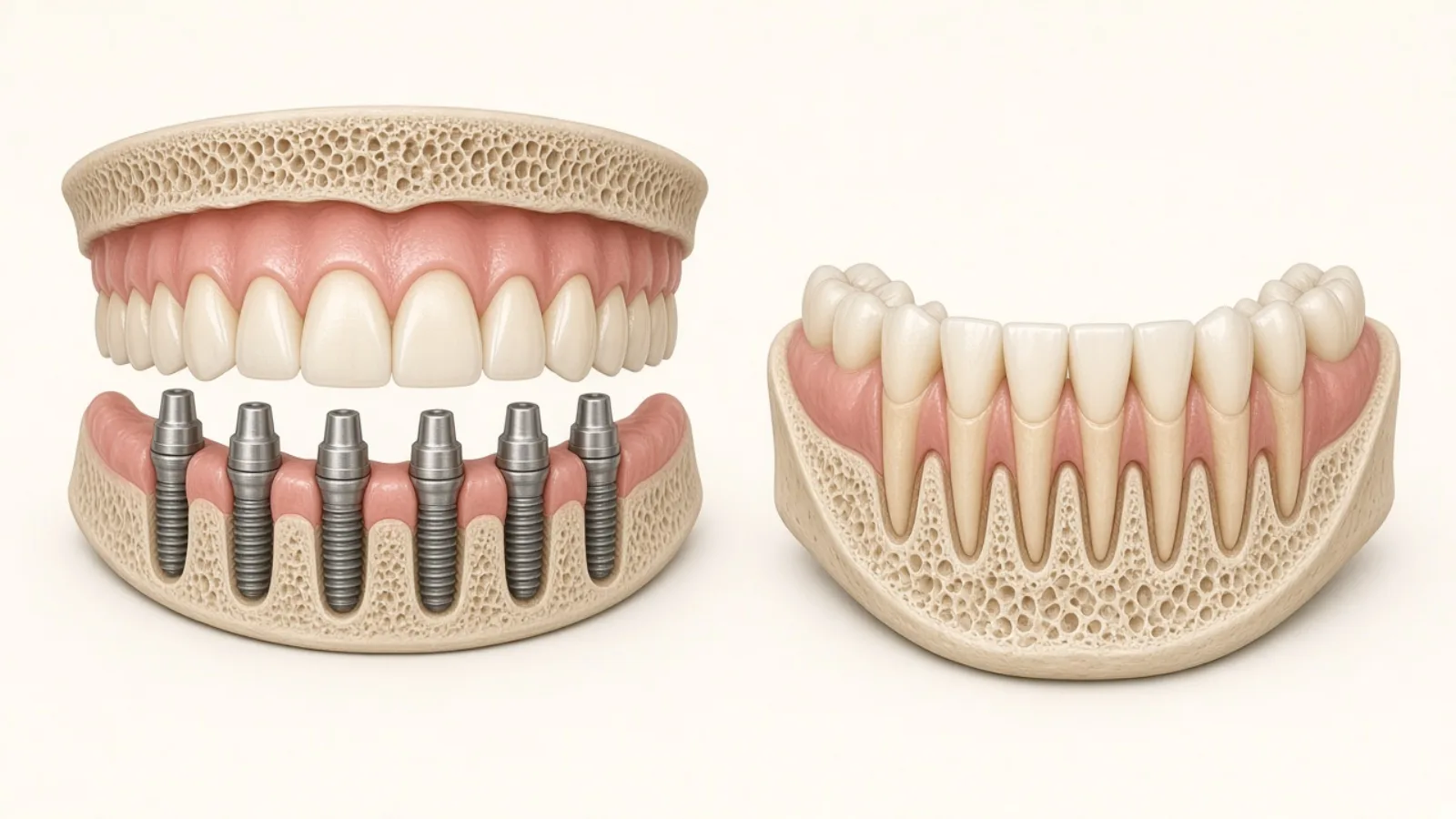
4. Single implants for missing teeth (a mixed plan)
Healthy teeth stay. Missing teeth, or teeth that cannot be kept, are replaced with a single implant or an implant-supported bridge. Your own teeth remain, and the gaps are filled. How long a single implant takes is summarised in how long dental implant treatment takes.
5. All-on in one jaw, your own teeth in the other
Each jaw is assessed separately. If the upper teeth cannot be kept, All-on-6 can be planned for the upper jaw while the lower teeth are treated and kept.
Is it right to keep a tooth at any cost?
Not always. Leaving a tooth in the mouth when its future cannot be predicted can lead to:
- Repeated inflammation and pain
- Continued loss of the surrounding bone, which later narrows the implant options
- For patients travelling from abroad, an extra trip and extra treatment cost
The aim is not "to leave as many teeth as possible in the mouth". It is a healthy, predictable result over the long term. We make the decision with you, with the advantages and the drawbacks on the table.
How the decision works at Bravodent
Bravodent was founded by two periodontists (PhD). Periodontology is the specialty that deals with the gum and bone that hold the teeth. Whether a tooth can be kept is therefore assessed separately for every patient.
- First review: You send smile photos and, if you have them, X-rays or a scan by WhatsApp or email.
- Examination and 3D scan: Bone support, pocket depth, mobility, and the root are assessed for each tooth.
- Tooth-by-tooth prognosis: We set out which teeth can be kept and which ones are at risk.
- A written plan with options: We present the alternatives, with teeth kept and with teeth not kept, including time, number of visits, and cost.
- The decision is yours: You decide after you have seen every option.
How long do saved teeth last?
A systematic review of 33 studies of patients who continued regular reviews after gum treatment found that most patients lost no teeth during long follow-up. Average tooth loss was about 1 tooth every 10 years (Carvalho et al., 2021).
The condition is regular reviews (every 3 to 6 months for most patients), professional cleaning, and good daily oral care.
For patients travelling from abroad
Some treatments, such as gum treatment, may need a review a few weeks later so healing can be assessed. We build the plan around your travel dates. When needed, some reviews are arranged together with your dentist at home.
|
Want to know whether your teeth can be kept? Send your photos and X-rays, and our team will assess them tooth by tooth. Phone: +90 546 112 07 24 • WhatsApp |
Frequently asked questions
Do all my teeth have to be removed for All-on-4?In the jaw where All-on-4 is placed, teeth that cannot be kept are usually removed, because natural teeth and implants are not joined in the same full-arch bridge. If some of your teeth are healthy, a different plan that keeps them can be considered instead of All-on-4. |
Can loose teeth be saved?It depends on the cause and the degree. Mild or moderate looseness from gum inflammation can lessen with treatment. With marked looseness from advanced bone loss, the tooth often cannot be kept long term. |
Can my own teeth and implants be in the same mouth?Yes. Mixed plans, in which healthy teeth are kept and missing teeth are replaced with implants, are common. What matters is that the teeth and the implants are planned separately. |
Can I have All-on-6 in one jaw and my own teeth in the other?Yes, that is possible. Each jaw is assessed on its own. |
Is keeping my teeth less costly than implants?Not always. Several teeth may need gum treatment, root canal treatment, and crowns, and those teeth also need regular maintenance. We therefore present both options side by side, with cost and long-term care. |
How do I find out which of my teeth can be kept?Sending your photos and, if you have them, X-rays or a scan is enough for a first review. The detailed plan becomes clear after the clinical examination and a 3D scan. |
Sources
- Azarpazhooh A, Dao T, Figueiredo R, Krahn M, Friedman S. A survey of patients' preferences for the treatment of teeth with apical periodontitis. J Endod. 2013;39(12):1534-1541.
- Herrera D, Sanz M, Kebschull M, et al. Treatment of stage IV periodontitis: The EFP S3 level clinical practice guideline. J Clin Periodontol. 2022;49(Suppl 24):4-71.
- Carvalho R, Botelho J, Machado V, et al. Predictors of tooth loss during long-term periodontal maintenance: An updated systematic review. J Clin Periodontol. 2021;48(8):1019-1036.
This article is for information only. A dental examination is required before any diagnosis or treatment decision. Individual results vary.