
Bravodent Blog • General Dentistry
Written by Dr. Dt. Deniz Burcu Mert, Endodontist (Root Canal Specialist), Bravodent Kadıköy • Last updated: 27 October 2026 • Reading time: about 8 minutes
|
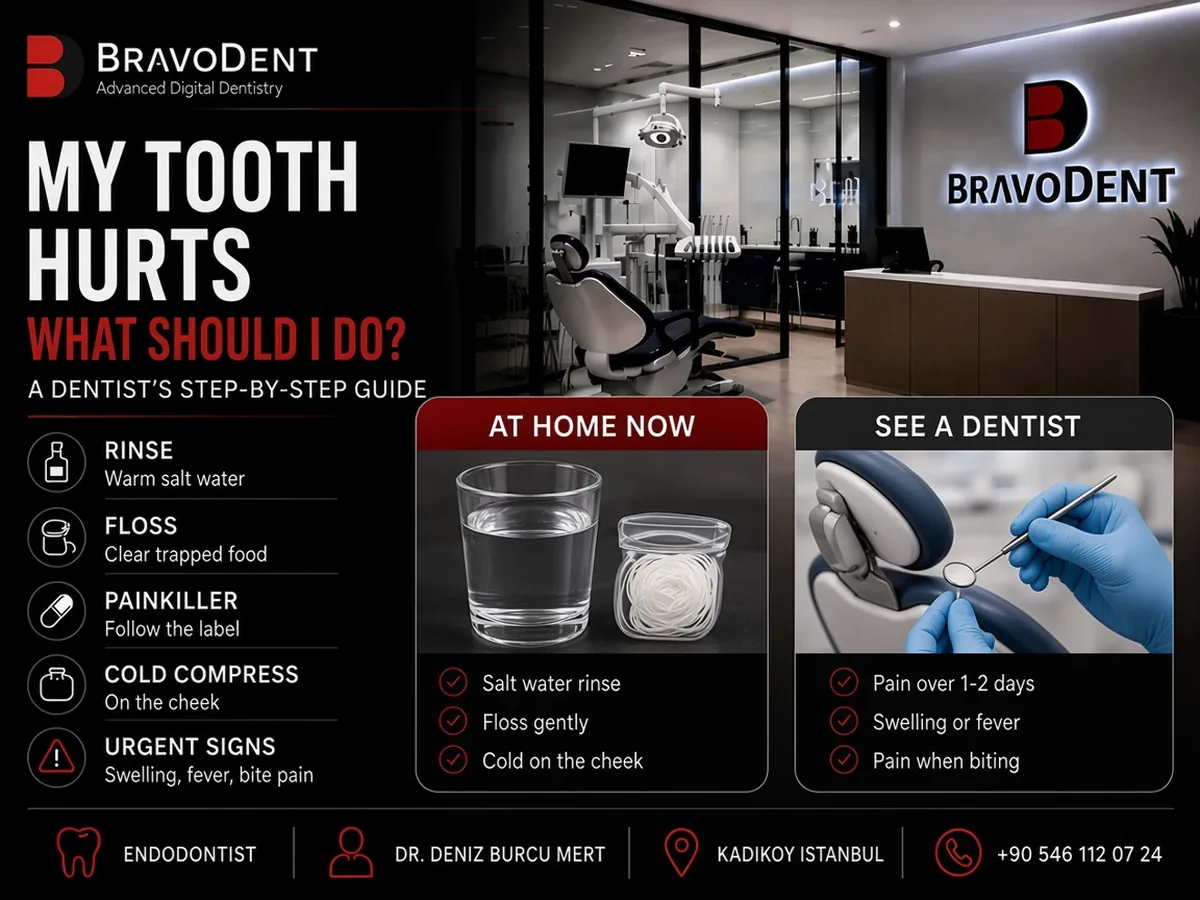
Quick answer If your tooth hurts, you can usually manage the pain safely at home for a short time:
See a dentist if the pain lasts more than 1–2 days, painkillers don’t help, or you have swelling, fever or pain when biting. Go to an emergency department immediately if swelling spreads towards your eye or neck, or you have difficulty breathing or swallowing. |
|
Medically reviewed: Dr. Dt. Deniz Burcu Mert • Endodontist |
Toothache is one of the most common reasons people contact a dentist — and one of the most stressful, because it rarely waits for a convenient moment. The good news: most toothaches have a clear cause and a predictable treatment. In this guide, our endodontist explains what you can safely do right now, what you should avoid, how to tell what your pain means, and when a toothache becomes an emergency.
What should I do right now if my tooth hurts?
These steps are safe for most adults while you arrange a dental appointment:
- Rinse with warm salt water. Dissolve about half a teaspoon of salt in a glass of warm water, swish gently and spit. It soothes irritated gums and helps clean the area. (Not suitable for young children.)
- Floss gently around the painful tooth. A trapped piece of food — popcorn husks and seeds are common culprits — can cause surprisingly strong pain and gum pressure.
- Take an over-the-counter painkiller. Ibuprofen (an anti-inflammatory) is often effective for dental pain; paracetamol is an alternative. Follow the label dose and check with a pharmacist if you are pregnant, have stomach, kidney or heart problems, asthma, or take other medicines.
- Use a cold compress. Hold an ice pack wrapped in a cloth against your cheek for 15–20 minutes at a time. Cold reduces swelling and dulls pain.
- Avoid triggers. Skip very hot, cold, sweet or acidic food and drinks, and chew on the opposite side.
- Keep your head raised at night. An extra pillow reduces blood pressure in the head, which often makes throbbing pain worse when lying flat.
- Call your dentist. Describe when the pain started, what triggers it and whether you have swelling or fever — this helps the clinic judge how urgently you need to be seen.
What should I NOT do?
- Don’t put aspirin or any tablet directly on the gum or tooth. It can cause a painful chemical burn of the gum.
- Don’t apply heat to a swollen face. Warmth can encourage an infection to spread.
- Don’t try to pop or drain a swelling yourself.
- Don’t take leftover antibiotics or someone else’s prescription. Wrong or incomplete courses don’t fix the cause and contribute to antibiotic resistance.
- Don’t rely on home remedies such as alcohol, crushed garlic or undiluted essential oils placed on the gum — they can irritate soft tissue and only mask the problem.
- Don’t assume it’s over when the pain stops. Sudden relief after days of throbbing can mean the nerve has died while the infection continues.
Why does my tooth hurt? What your pain may be telling you
The type of pain gives your dentist important clues. Use this table as a rough guide only — a clinical exam and X-ray are needed for a diagnosis.
| What you feel | Possible cause | How soon to see a dentist |
| Short, sharp twinge with cold or sweet that fades within seconds | Tooth sensitivity, early decay, exposed root surface | Routine appointment (within a few weeks) |
| Pain that lingers for 30 seconds or more after hot or cold | Inflamed nerve (pulpitis) from deeper decay or a leaking filling | Within 1–2 days |
| Spontaneous throbbing pain, worse at night, wakes you up | Irreversibly inflamed nerve — often needs root canal treatment | Urgent — within 24 hours |
| Pain when biting, tooth feels “high”, swollen gum, bad taste | Dental abscess (infection at the root tip or in the gum) | Urgent — same or next day |
| Sharp pain when biting down or releasing | Cracked tooth | Soon — within a few days |
| Pain and swollen gum behind the last molar, hard to open mouth | Wisdom tooth infection (pericoronitis) | Soon; urgent if swelling increases |
| Dull ache in several upper back teeth, worse when bending forward | Sinus congestion (sinusitis) | See a dentist or doctor to rule out a tooth cause |
| Morning jaw ache, headaches, worn or chipped teeth | Teeth grinding (bruxism) | Routine appointment |
| Tooth broken, loosened or knocked out after a blow | Dental trauma | Same day — as soon as possible |
Related reading: Root canal treatment • Wisdom tooth surgery • Gum (periodontal) diseases • Teeth grinding (bruxism) • Dental injuries and trauma
When is a toothache an emergency?
See a dentist within 24 hours if you have:
- Severe pain that over-the-counter painkillers do not control
- Swelling of the gum, cheek or jaw
- Fever or feeling generally unwell together with toothache
- Pain when biting, red gums or a bad taste or pus in the mouth
- A broken, loose or knocked-out tooth
Go to a hospital emergency department immediately (112 in Turkey) if you have:
- Swelling spreading towards the eye, down the neck or under the tongue
- Difficulty breathing, swallowing or speaking
- Inability to open your mouth properly
- High fever with facial swelling
- Bleeding that will not stop, or a serious facial injury
|
Important Spreading dental infections can become serious. If you are unsure, it is always safer to be seen early. |
Why does toothache get worse at night?
When you lie down, more blood flows to your head and the pressure inside an inflamed tooth rises — so throbbing pain often intensifies. At night there are also fewer distractions, and grinding during sleep can add pressure. Sleeping with your head slightly raised and taking a painkiller (as directed) before bed can help until your appointment. Pain that regularly wakes you up is a sign the nerve is significantly inflamed.
Will antibiotics fix my toothache?
In most cases, no. Antibiotics do not treat an inflamed nerve or decay, which are the most common causes of toothache. They may be prescribed when an infection is spreading — for example with facial swelling or fever — but the source of the infection still has to be treated by your dentist, usually by root canal treatment, draining the abscess or removing the tooth.
How will a dentist treat my toothache?
At Bravodent, treatment always starts with finding the exact cause:
- Clinical examination — checking the tooth, gums and bite, plus simple cold and tapping tests to assess the nerve.
- Imaging — a periapical X-ray of the tooth, and, when needed, 3D cone-beam tomography (CBCT) for complex roots, cracks or wisdom teeth.
Depending on the diagnosis, treatment may include:
| Cause | Typical treatment |
| Decay or a broken filling | A new filling, or an inlay/onlay for larger cavities |
| Inflamed or infected nerve | Root canal treatment to remove the inflamed tissue and save the tooth |
| Dental abscess | Draining the infection and treating the root canal; antibiotics only if the infection is spreading |
| Persistent infection after a root canal | Re-treatment or apicoectomy (root-end surgery) |
| Gum infection | Periodontal treatment — deep cleaning and gum care |
| Problematic wisdom tooth | Cleaning and medication, or surgical removal |
| Teeth grinding | A custom night guard and bruxism management |
| Tooth that cannot be saved | Extraction, followed by a replacement option such as a dental implant |
Is root canal treatment painful?
Modern root canal treatment is carried out under local anaesthesia and, for most patients, feels similar to having a filling. Its purpose is to remove the source of the pain — many patients feel significant relief afterwards. Mild tenderness when biting for a few days is normal and usually settles with ordinary painkillers.
Toothache while travelling or before a flight
A toothache abroad can be especially worrying. Changes in cabin pressure can make an already inflamed or infected tooth more painful, so if you have active pain or swelling, get the tooth checked before you fly. If you are visiting Istanbul — or planning dental treatment here — our international patient team can help in English, German, Russian, French and Arabic. Learn more about dental tourism at Bravodent and whether dental treatment in Turkey is safe.
How can I prevent toothache?
- Brush twice a day with a fluoride toothpaste and clean between your teeth daily
- Limit how often you have sugary snacks and drinks
- Have a dental check-up and professional cleaning regularly — usually every six months
- Don’t ignore early sensitivity or bleeding gums — small problems are easier and cheaper to treat
- Wear a night guard if you grind your teeth, and a mouthguard for contact sports
Toothache treatment at Bravodent Kadıköy, Istanbul
Bravodent is a dental clinic in Bostancı, Kadıköy, on the Anatolian side of Istanbul, authorised by the Ministry of Health of Türkiye as a health tourism provider. Toothache cases are assessed by our team, which includes a specialist endodontist (root canal specialist), an oral surgeon, periodontists and a paediatric dentist for children.
|
Have a toothache right now? WhatsApp / Phone: +90 546 112 07 24 Address: Bostancı Mah. Şemsettin Günaltay Cad., Dar Yol Sk. Güzide Apt. No 35A, 34744 Kadıköy / İstanbul Opening hours: Monday–Saturday, 10:00–19:00 Send us a short description of your symptoms and we will advise you on how urgently you should be seen. |
Frequently asked questions about toothache
Can a toothache go away on its own?Mild sensitivity or gum irritation from trapped food can settle within a day or two. Pain caused by decay, a cracked tooth or infection does not heal by itself. If throbbing pain suddenly stops, the nerve inside the tooth may have died — the infection usually continues silently and can later flare up as an abscess. Have the tooth checked even if the pain has gone. |
How long can I wait before seeing a dentist?Book an appointment if the pain lasts more than 1–2 days or painkillers do not control it. Seek care within 24 hours if you have swelling, fever, pain on biting or a bad taste in your mouth. Facial swelling spreading towards the eye or neck, or difficulty breathing or swallowing, needs emergency care immediately. |
Which painkiller is best for a toothache?For most adults, an over-the-counter anti-inflammatory such as ibuprofen works well for dental pain, and paracetamol is an alternative. Always follow the dose on the label and ask a pharmacist first if you are pregnant, have stomach, kidney or heart problems, asthma, or take other medicines. Painkillers only buy time — they do not treat the cause. |
Can a toothache cause headache or ear pain?Yes. Pain from upper and lower back teeth is often felt in the ear, temple, jaw or as a headache, because these areas share nerve pathways. Teeth grinding can also cause morning headaches and jaw pain. A dental exam helps find the real source. |
Does a salt water rinse help a toothache?A warm salt water rinse (about half a teaspoon of salt in a glass of warm water) can soothe irritated gums and help keep the area clean. It is a comfort measure, not a cure, and is not recommended for young children who may swallow it. |
Why does my tooth hurt after a filling?Mild sensitivity to cold or biting for a few days to a couple of weeks after a filling is common. If the bite feels high, the pain is getting worse, or it starts waking you at night, contact your dentist — the bite may need adjusting or the nerve may need further assessment. |
Should I go to a hospital or a dentist for toothache?For toothache, a dentist is almost always the right place, because hospitals usually cannot treat the tooth itself. Go to a hospital emergency department (call 112 in Turkey) only if you have spreading facial swelling, difficulty breathing, swallowing or opening your mouth, a high fever, or a serious facial injury. |
Can I fly with a toothache?Changes in cabin pressure can make an already inflamed or infected tooth hurt more. If you have an active toothache, swelling or a recently treated tooth, ask your dentist before flying. |
About the author
|
Dr. Dt. Deniz Burcu Mert Endodontist • Root Canal Specialist Dr. Dt. Deniz Burcu Mert is an endodontist (root canal specialist) at Bravodent International Dental Clinic in Kadıköy, Istanbul. She focuses on diagnosing the cause of dental pain and saving natural teeth with root canal treatment. She sees patients in Turkish, English and German. |
Medical disclaimer: This article is for general information and does not replace a personal examination. If you have severe pain, swelling or fever, contact a dentist or emergency services without delay.
References
Bravodent | Kadıköy, Istanbul | Authorised by the Turkish Ministry of Health. This content is for information. Ask your dentist about your own dental health.