
Bravodent Blog • Patient Comfort
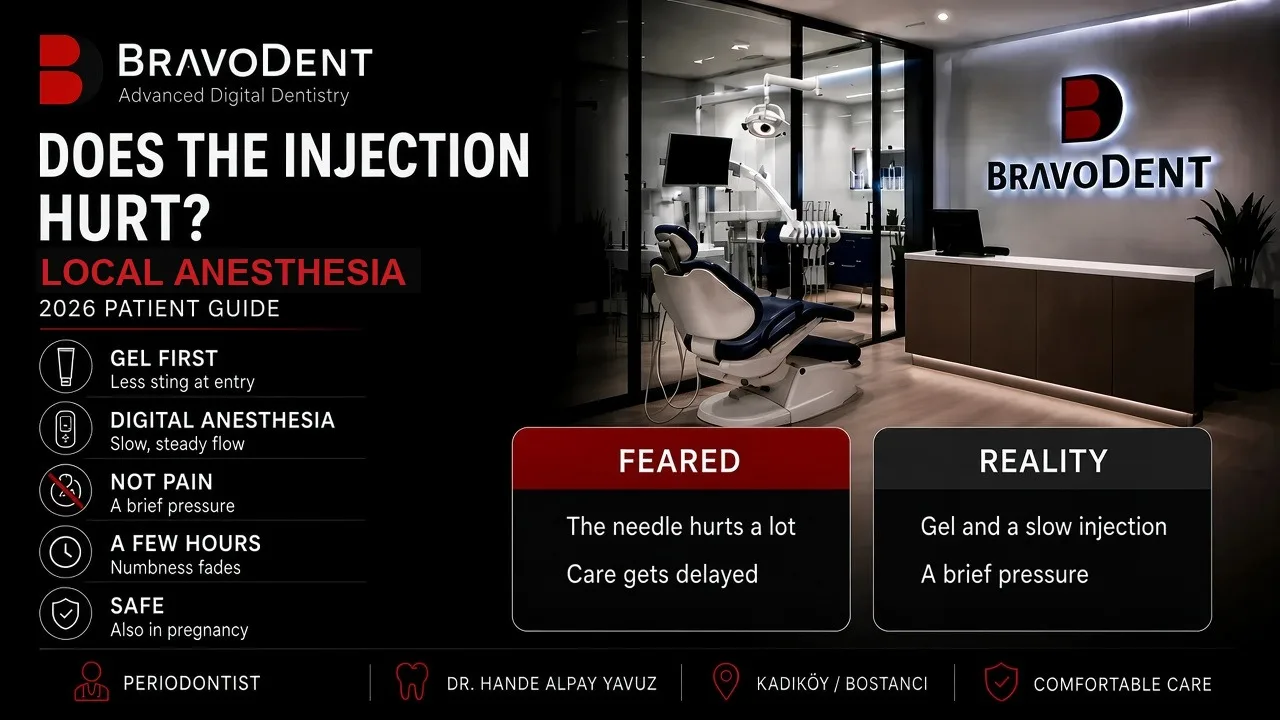
Short answer: Dental anesthesia (local anesthesia) is not as painful as most people fear. When numbing gel is applied to the gum first and the anesthetic is given slowly, if needed with computer-controlled (digital) anesthesia, what you feel is usually only a brief pressure or a slight sting. Numbness starts within a few minutes and you do not feel pain in that area during treatment; touch and pressure can still be felt. Local anesthesia is one of the most common and safest procedures in dentistry.
|
Medically reviewed: Dr. Hande Alpay Yavuz, DDS, PhD • Periodontist, Bravodent Kadıköy Last updated: November 2026. This content is for information only. It does not diagnose and does not replace an examination. |
|
Quick guide
|
Why is the needle the main source of dental fear?
Dental fear is common. A meta-analysis of studies in adults found that about 1 in 6 to 7 adults has significant dental fear (Silveira et al., 2021). One of the reasons people mention most often is the numbing injection.
The problem is that fear of the needle leads people to postpone treatment. A small cavity that is delayed can become a root canal. Untreated gum inflammation can lead to tooth loss. The paradox is this: avoiding the needle often leads to longer and more extensive treatment. This article explains what actually happens during numbing, so the unknown is no longer the problem.
What is local anesthesia and how does it work?
Local anesthesia temporarily stops the nerves in the area being treated from sending a pain signal to the brain. The anesthetic briefly closes sodium channels in the nerve cell membrane. Because the signal cannot travel, pain from that area is not felt. When the effect wears off, the nerve returns completely to normal function.
Unlike general anesthesia, you are fully awake. You can talk, hear your dentist, and signal at any moment. Pain is blocked, while touch and pressure often remain. Feeling that "something is being done" during treatment is normal. That sensation is not pain.
Which numbing methods are used in dentistry?
| Method | Where it is used | What you feel |
| Topical anesthesia | A gel is applied to the gum before the injection. | Mild numbness and a taste that may be unpleasant. It reduces the feeling of the needle entering. |
| Infiltration anesthesia | Especially for upper teeth, placed right next to the tooth. | A brief pressure. The area numbs within a few minutes. |
| Block (nerve) anesthesia | For lower molars, where the nerve lies further back. | Numbness of the tongue, lip, and half of the jaw. The effect is wider and lasts longer. |
| Computer-controlled (digital) anesthesia | The anesthetic is delivered by a device at a steady, slow rate. | There is no sudden pressure, so most people feel the injection less. |
Does dental anesthesia hurt? What is done so you barely feel the needle
Most of the discomfort during an injection comes not from the needle itself, but from the anesthetic liquid entering the tissue quickly and under pressure. Modern dentistry therefore aims to control both the entry of the needle and the speed of the injection.
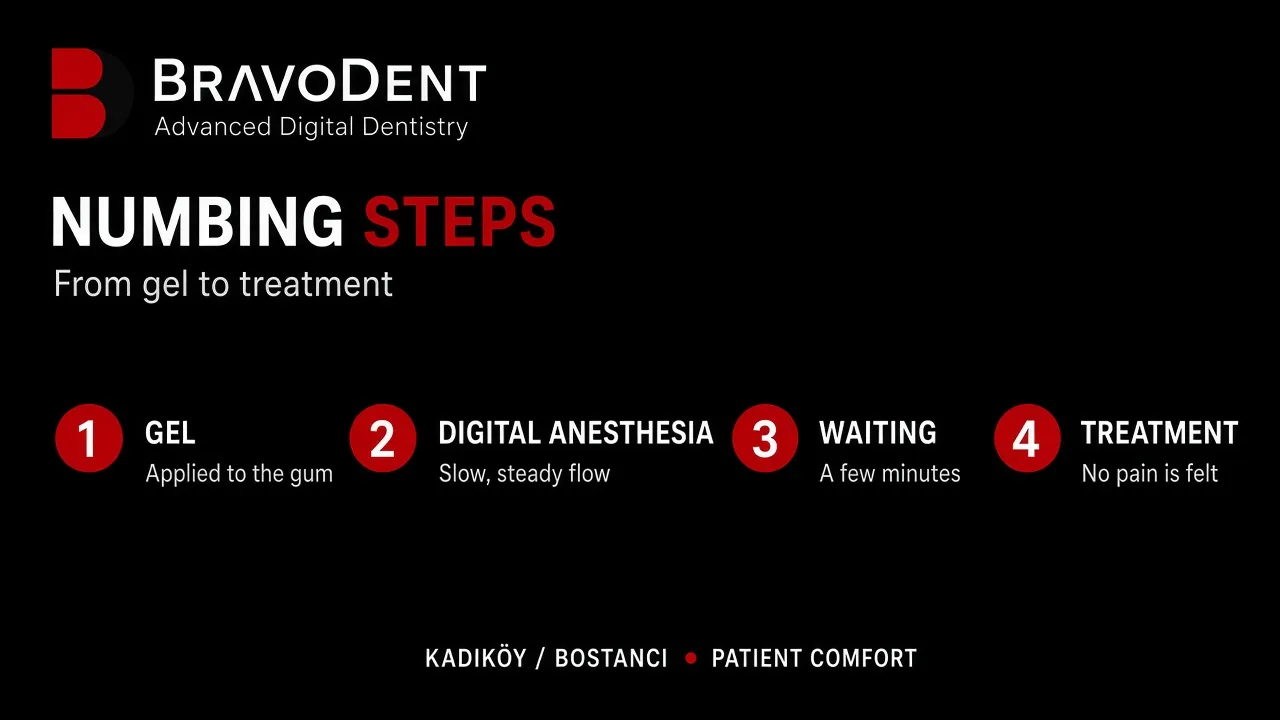
1. Numbing gel (topical anesthesia)
Before the injection, the gum is dried and a surface numbing gel is applied. The gel numbs the surface the needle first touches. A systematic review of 22 randomized controlled trials and 1,029 patients showed that topical anesthesia significantly reduces needle-entry pain, especially in the upper jaw and palate (Maia et al., 2021).
2. Computer-controlled (digital) anesthesia
With digital anesthesia, the anesthetic is given by a computer-controlled device at a steady, very slow rate, instead of a syringe pushed by hand. A slim, pen-like tip is used, so the look of a classic syringe is gone. That matters especially for people who dislike seeing a needle.
A meta-analysis of 8 crossover studies and 241 patients found that computer-controlled anesthesia produced significantly less perceived pain than a conventional injection (Libonati et al., 2018). The difference is measurable, not dramatic. The best result comes from using digital anesthesia together with gel and the right technique.
3. Technique and communication
- The anesthetic liquid is close to body temperature
- The tissue is gently stretched and the finest needle is used
- The liquid is given slowly, without rushing
- What will happen is explained beforehand, and a "stop" signal is agreed
- The dentist waits a few minutes until the numbness is fully in place, and only then starts treatment
What "the anesthetic does not work on me" means
Some patients describe feeling pain despite being numbed, and that experience becomes the strongest source of fear. There is usually a clear scientific explanation:
- Anesthetic works less well in inflamed tissue. The more acidic environment of inflamed tissue reduces the active form of the anesthetic that reaches the nerve. Inflammation also makes nerves easier to stimulate.
- Numbing is harder when the tooth pain is severe. In teeth with irreversible pulpitis (painful inflammation of the tooth nerve), the risk that anesthesia is not enough is clearly higher than in a healthy tooth (Boopathi et al., 2013).
- Anatomic differences. Especially in the lower jaw, the position of the nerve varies from person to person.
- Anxiety. Strong anxiety lowers the pain threshold and can make ordinary sensations feel like pain.
The good news: in all of these situations the dentist has additional numbing techniques. With extra injection methods, enough numbness can usually be achieved even in inflamed teeth. What matters is that you say so immediately if you feel pain during treatment. You do not have to endure pain. Treating a toothache before it grows also makes the numbing easier and more comfortable. For painful tooth treatment, you can read our root canal guide.
How long does dental anesthesia last, and when does it wear off?
Numbness in the tooth is planned to last through the treatment. Numbness of the lip, cheek, and tongue usually wears off on its own within a few hours. It depends on the anesthetic, the site (especially a lower-jaw block), and the person. A mild tingling as it wears off is normal.
What to do until the numbness fades
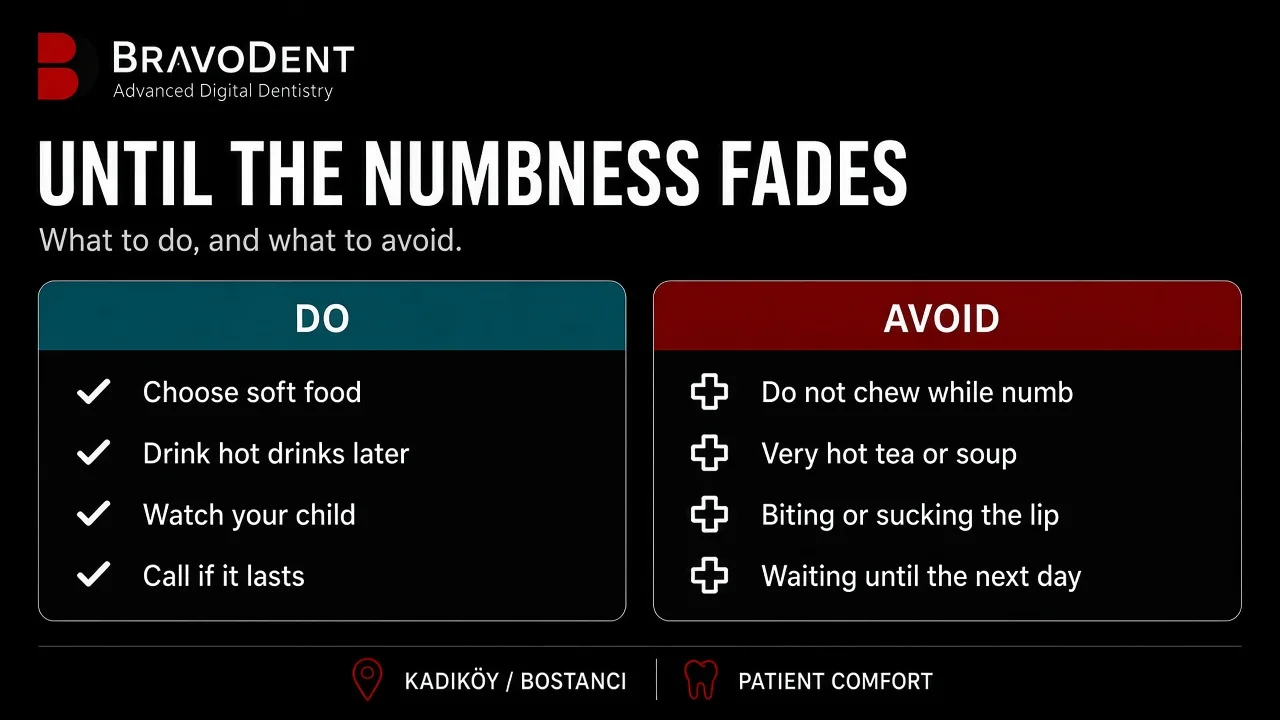
| Do | Avoid |
| Choose liquids or very soft food until the numbness fades. | Eating food that needs chewing while you are numb (you can bite your cheek or tongue). |
| Drink hot drinks after the numbness has gone. | Very hot tea or soup (you may burn yourself because you cannot feel the heat). |
| Keep a child supervised until the numbness fades. | Children biting or sucking a numb lip out of curiosity (a common cause of injury). |
| Call the clinic if numbness lasts a long time. | Waiting if numbness is still there the next day. |
For dental anxiety in children, see our guide to dental fear in children.
Is local anesthesia safe? Who should tell the dentist beforehand?
Local anesthesia is used millions of times a day in dentistry, and its safety profile is well known. Even so, tell your dentist about the following before the examination, so the right anesthetic and dose can be chosen:
| Situation | Why it matters |
| Pregnancy | The American Dental Association (ADA) states that local anesthesia can be used safely in every stage of pregnancy. The dentist still plans the timing and the anesthetic accordingly. |
| Heart disease, high blood pressure | Some anesthetics contain a vasoconstrictor. The dentist chooses the suitable type and amount. |
| Blood-thinning medicine | Planning is needed especially for block anesthesia and surgical procedures. Do not stop the medicine on your own. |
| A previous reaction | Fainting, palpitations, or a rash should always be mentioned. |
| All medicines and chronic conditions | Thyroid disease, diabetes, and some psychiatric medicines can affect the choice of anesthetic. |
Can you be allergic to dental anesthesia?
A true allergy to the modern (amide) local anesthetics used in dentistry is extremely rare. The literature estimates that fewer than 1% of all unwanted reactions are a true allergy (Henderson, 2011). Most events thought to be an "allergy" are actually anxiety-related faintness, palpitations, trembling, or sweating. The vasoconstrictor in the anesthetic can also cause a short feeling of a racing heart. That usually passes within a few minutes. If a true allergy is suspected, your dentist can refer you for allergy testing.
7 practical tips if you are afraid of the dentist
- Say you are afraid when you book. Your dentist can plan a longer, calmer first visit.
- Agree a "stop" signal. For example, raising your left hand. Knowing you are in control clearly reduces anxiety.
- Ask to be told each step. Knowing what will happen prevents the panic that unexpected sensations can cause.
- Ask about numbing gel and digital anesthesia. These methods exist to minimize the feeling of the needle.
- Book a morning appointment. Waiting through the day can increase anxiety.
- Do not come hungry, and cut back on caffeine. A light meal reduces the chance of feeling faint. Too much caffeine can increase a racing-heart feeling.
- Split treatment into small steps. The first visit can be an examination and a cleaning only. More extensive treatment follows once trust is there.
Comfortable numbing at Bravodent Kadıköy
At Bravodent, numbing gel is applied to the gum before the injection, and the anesthetic is given with the SleeperOne computer-controlled digital anesthesia system developed by the French company Dental Hi Tec, at a steady, slow rate. This pen-shaped system does not use a classic syringe. The device sets a speed that does not create pressure in the tissue. The aim is that the patient barely feels the needle. Treatment starts only after the numbness is confirmed to be fully in place, and the patient is kept informed throughout.
For patients who have postponed treatment for a long time because of dental fear, we can use the first visit only for meeting, examination, and treatment planning. The same comfort protocol is used for deep cleaning, including gum treatment and bleeding while brushing.
|
Do not let fear of the needle delay your treatment Tell us you are afraid. We will plan a comfortable visit with numbing gel and SleeperOne digital anesthesia. You can book at our clinic in Bostancı, Kadıköy. Phone: +90 546 112 07 24 • WhatsApp |
Frequently asked questions
Does dental anesthesia hurt?For most people, no. Numbing gel is applied before the injection and the anesthetic is given slowly. What you feel is usually a brief pressure or a slight sting. Once you are numb, you do not feel pain during treatment. |
What is digital anesthesia? Is it needle-free?In digital (computer-controlled) anesthesia, a device delivers the anesthetic at a steady, very slow rate. It is not completely needle-free, but a very fine tip is used and there is no sudden pressure, so the injection is felt less than with the conventional method. |
How long does dental anesthesia last?Numbness usually starts within a few minutes. Numbness of the lip, cheek, and tongue usually fades within a few hours, depending on the anesthetic and the site. A lower-jaw block can last longer. |
What if the anesthetic does not work?Anesthesia can be harder to achieve, especially in an inflamed or very painful tooth. The dentist then uses additional numbing techniques. If you feel pain during treatment, say so at once. You do not have to endure it. |
Is it normal to feel something while I am numb?Yes. Local anesthesia blocks pain, but touch, vibration, and pressure can remain. Those sensations are not pain. |
Can dental anesthesia be used in pregnancy?Yes. The American Dental Association (ADA) states that local anesthesia can be used safely in every stage of pregnancy. Always tell your dentist you are pregnant before the examination. |
Can you be allergic to dental anesthesia?A true allergy to modern local anesthetics is extremely rare. Most events thought to be an allergy are faintness from anxiety or a short spell of palpitations. If you have had a reaction before, tell your dentist. |
When can I eat after the anesthetic?Until the numbness has completely gone, avoid food that needs chewing and hot drinks. You could bite your cheek or tongue, or burn your mouth because you cannot feel the heat. |
I have a heart condition. Can I still have dental anesthesia?Local anesthesia can be used safely for most people with heart disease. Your dentist chooses the type and amount for your health. Always mention your heart condition and your medicines before the examination. |
I am afraid of the dentist. What should I do?Tell your dentist when you book and again at the examination. A "stop" signal, being told each step, numbing gel and digital anesthesia, and splitting treatment into short visits clearly reduce anxiety. |
Why this content is trustworthy
|
Dr. Hande Alpay Yavuz, DDS, PhD Periodontist This article was prepared and medically reviewed by Bravodent periodontist Dr. Hande Alpay Yavuz, DDS, PhD. Dr. Yavuz graduated from Ondokuz Mayıs University Faculty of Dentistry, completed her periodontology doctorate at Istanbul University in 2014, and has more than 17 years of clinical experience. The information is based on the American Dental Association (ADA) and on systematic reviews and meta-analyses published in peer-reviewed journals. |
Sources
- Silveira ER, Cademartori MG, Schuch HS, Armfield JA, Demarco FF. Estimated prevalence of dental fear in adults: A systematic review and meta-analysis. J Dent. 2021;108:103632.
- Libonati A et al. Pain and anxiety associated with Computer-Controlled Local Anaesthesia: systematic review and meta-analysis of cross-over studies. Eur J Paediatr Dent. 2018;19(4):324-332.
- Sivaramakrishnan G, Sridharan K. Local Anaesthetic Drug Administration in Dentistry Using Computer Assisted Anaesthetic Delivery System: A Systematic Review. Open Dent J. 2016;10:454-459.
- Maia FPA et al. Topical anaesthesia and pain perception of local anaesthetic injections: systematic review and meta-analysis. Int J Oral Maxillofac Surg. 2021.
- Boopathi T et al. Supplemental pulpal anesthesia for mandibular teeth. J Pharm Bioallied Sci. 2013;5(Suppl 1):S103-S108.
- Henderson S. Allergy to local anaesthetic agents used in dentistry. Dental Update. 2011;38(6):410-412.
- American Dental Association: Pregnancy (Oral Health Topics)
This content is for information only. A dental examination is required for personal diagnosis and treatment.