
Bravodent Blog • Implantology
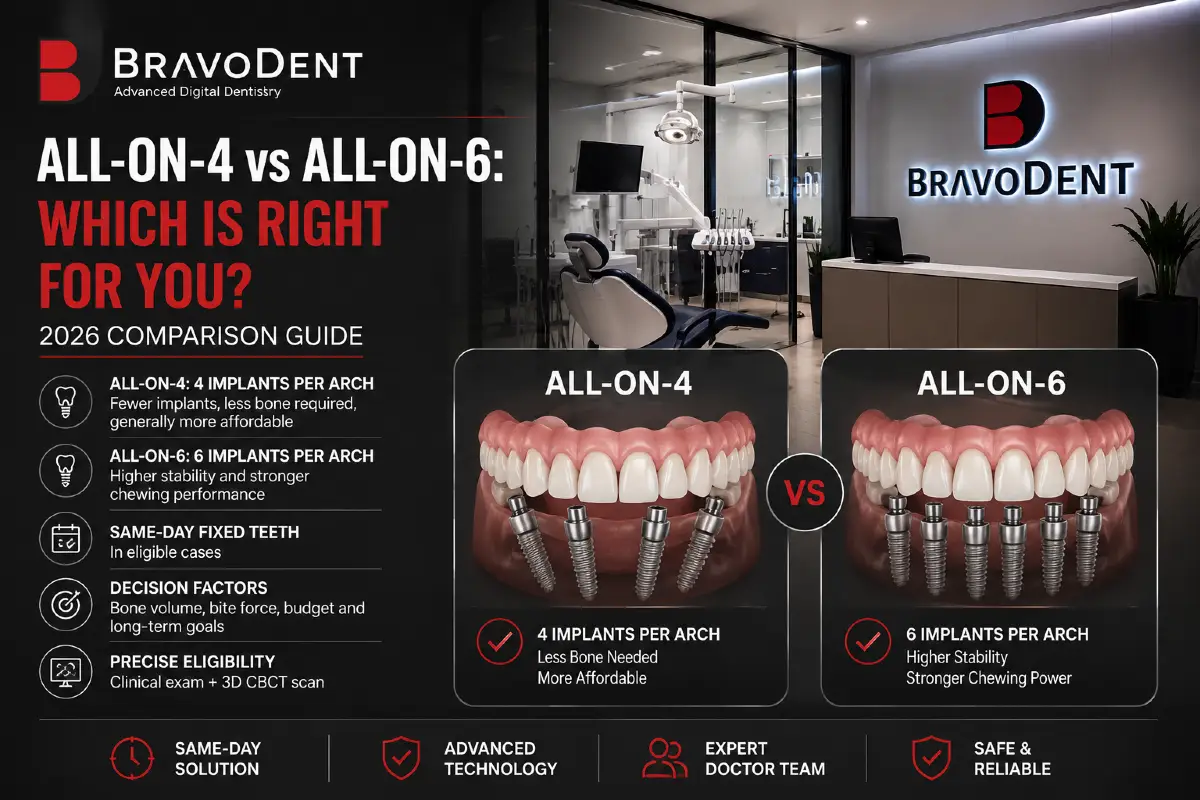
The main difference between All-on-4 and All-on-6 is the number of implants per jaw: All-on-4 uses 4 implants; All-on-6 uses 6. All-on-6 offers higher stability and chewing strength; All-on-4 can be placed with less bone volume and is usually more cost-effective. Which protocol is right depends on bone volume, bite force and treatment goals, assessed with 3D tomography (CBCT). There is no single “better” method for everyone.
|
🩺 Medically reviewed: Dr. Ümit Sait Yavuz (DDS, PhD) — Oral Surgeon, Implantologist, Periodontologist |
|
⚡ Quick Comparison
|
All-on-4 Treatment
All-on-4 is a full-mouth rehabilitation method that places a fixed full-arch prosthesis on 4 titanium implants per jaw for patients who have lost all their teeth or whose remaining teeth need extraction. A separate implant is not placed for every tooth. Implants are angled to use available bone as efficiently as possible; posterior implants are often tilted. This means additional surgery such as sinus lifting or extensive bone grafting is unnecessary in many cases.
All-on-4 is often preferred by patients with moderate bone volume who want a shorter, more cost-effective path to fixed teeth. In suitable cases, a fixed temporary prosthesis is fitted on the day of surgery; the permanent prosthesis is placed after osseointegration (fusion of the implant with the bone). Treatment page: All-on-4 and All-on-6 implant treatment.
All-on-6 Treatment
All-on-6 applies the same full-arch concept with 6 implants per jaw. The two extra implants spread chewing load over a wider area. The aim is a more stable prosthesis over time, higher chewing force, and less stress on any single implant.
All-on-6 stands out for patients who have enough bone and want maximum security. The process is similar to All-on-4: digital planning, extraction and implant placement in the same session, same-day temporary fixed teeth in suitable cases, then a permanent prosthesis after 3–6 months. For a closer look at All-on-6, see All-on-6 dental implants in Istanbul.
All-on-4 vs All-on-6: Key Differences
Both methods aim for fixed, non-removable full-arch teeth. The difference is in the number of supports, bone requirement, load distribution and cost:
| Criterion | All-on-4 | All-on-6 |
| Number of implants | 4 per jaw | 6 per jaw |
| Stability | Good | Higher |
| Chewing strength | Adequate / good | Stronger load distribution |
| Bone volume needed | Moderate bone is enough | More bone is required |
| Bone graft / sinus lift | Avoidable in most cases | May be needed if bone is insufficient |
| Same-day fixed temporary teeth | Yes, in suitable cases | Yes, in suitable cases |
| Treatment cost | Lower | Higher (2 extra implants + prosthesis plan) |
| Long-term reliability | Very good | Excellent load sharing |
| Typical patient profile | Moderate bone; budget- and time-focused | Adequate bone; wants maximum stability |
Which Should You Choose: A Short Decision Guide
The decision is not “pick the more modern option”. It is which protocol matches your bone and your expectations:
|
All-on-4 may be more suitable if:
All-on-6 may be more suitable if:
|
If there is advanced bone loss in the upper jaw, neither All-on-4 nor All-on-6 may be enough. In those cases, a zygomatic implant protocol is considered, with implants placed in the cheekbone instead of the jawbone.
Who Are All-on-4 and All-on-6 Suitable For
Both methods differ from a classic single-tooth implant. The goal is to rebuild an edentulous jaw, or a jaw whose teeth cannot be saved, with a fixed prosthesis. Typical candidates:
- Patients who have lost all teeth or whose remaining teeth need extraction
- Patients who do not want a removable denture and want fixed teeth
- Full-arch cases with loss of speech, chewing and confidence
- Patients whose general health is suitable for surgery and healing
- Patients who will follow oral hygiene and regular check-ups after treatment
Uncontrolled diabetes, active gum infection, heavy smoking or insufficient bone can change or postpone the plan. A definitive decision is made only after examination and CBCT. Conventional dental implant options are also reviewed in the same assessment.
How the Treatment Process Works
All-on-4 and All-on-6 follow the same framework. The difference is the number of implants placed and the digital plan built around that number.
|
1 |
Examination and 3D PlanningClinical exam, panoramic imaging and CBCT are used to assess bone volume, the sinus, the nerve canal and the bite. The All-on-4 vs All-on-6 decision is clarified at this stage. |
|
2 |
Surgery: Extraction and ImplantsTeeth that cannot be saved are extracted in the same session; 4 or 6 implants are placed at the planned angles. The procedure is done under local anaesthesia, with sedation if needed. |
|
3 |
Same-Day Fixed Temporary ProsthesisIf primary stability is sufficient, a fixed temporary prosthesis is fitted the same day. The patient leaves without remaining edentulous; a soft diet is recommended in the first weeks. |
|
4 |
Healing and Permanent ProsthesisOsseointegration usually takes 3–6 months. Then a zirconium or porcelain permanent prosthesis is placed to match facial form. Follow-up visits are scheduled regularly. |
Same-Day Fixed Teeth
In suitable cases, yes, for both All-on-4 and All-on-6. The condition is that the implants have enough primary stability at placement. The teeth fitted on the same day are not the permanent prosthesis; they are a fixed temporary prosthesis that provides function and aesthetics during healing. The permanent prosthesis is made after bone–implant fusion. “Same-day teeth” is not automatic for every anatomy.
What Affects the Cost
All-on-6 costs more than All-on-4 because of two extra implants, a more extensive surgical plan and the prosthesis design. The main factors that set the final price:
- Number of jaws (one jaw or both)
- Whether All-on-4 or All-on-6 is selected
- Implant brand and prosthesis material (temporary + permanent)
- Need for extractions, grafting or additional surgery
- Sedation / anaesthesia preference and follow-up protocol
|
The situation at Bravodent: After the first examination and imaging, we share a personalised treatment plan and itemised cost breakdown. A ready-made package price is not used to push a protocol that does not match your bone. For implant treatment in Turkey, see also our dental implants page. |
Longevity, Care and Success
With correct case selection, an experienced surgical team and regular care, All-on-4 and All-on-6 implants can last 15–25 years, and often longer. The prosthesis surface can wear or be renewed over time; the infrastructure is preserved as long as the implants remain integrated in bone. Longevity depends on a night guard when needed, cleaning around the prosthesis, peri-implant gum health and six-monthly check-ups. The extra implants in All-on-6 share the load; that does not mean All-on-4 is “short-lived”.
|
The situation at Bravodent: Every jaw has a different bone density and bite pattern. A realistic forecast of longevity and protocol for your case can only be given after a tomography assessment. |
All-on-4 and All-on-6 Planning at Bravodent
At Bravodent in Kadıköy / Bostancı, Istanbul, full-mouth rehabilitations are planned by a team experienced in periodontology, implantology and oral surgery, together with CBCT and digital impression technology. Under clinical supervision, Dr. Ümit Sait Yavuz is actively involved in dental implant, All-on-4, All-on-6 and zygomatic implant cases. The goal is not to sell “6 implants for everyone” or “4 implants for everyone”; it is to choose the protocol that matches the bone and the function. Same-day fixed temporary prostheses and a transparent treatment plan are offered, including for patients travelling from Europe.
Frequently Asked Questions
What is the difference between All-on-4 and All-on-6?The main difference is the number of implants. All-on-4 uses 4 implants per jaw; All-on-6 uses 6. All-on-6 provides more stability and chewing support; All-on-4 can be applied with less bone and is usually more economical. |
Is All-on-4 or All-on-6 better?There is no universally better method. All-on-6 stands out for patients with enough bone and high chewing expectations; All-on-4 may be the right choice if bone is more limited or a more cost-effective fixed solution is needed. The decision is made after CBCT. |
Can teeth be fitted on the same day with All-on-4 and All-on-6?In suitable cases, yes. If the implants have enough primary stability, a fixed temporary prosthesis is fitted the same day. The permanent prosthesis usually follows 3–6 months of healing. |
Is All-on-6 more durable than All-on-4?All-on-6 usually has a higher mechanical reserve because the load is shared across more implants. All-on-4 also works for many years when planned correctly. Durability depends on bone quality, prosthesis design and care. |
What happens if there is not enough bone for All-on-4?Tilted implant placement, short implants or grafting are considered first. In advanced upper-jaw bone loss, a zygomatic implant protocol may be discussed. “No bone” does not by itself mean treatment is impossible. |
What is the price difference between All-on-4 and All-on-6?All-on-6 costs more than All-on-4 because of two extra implants and a more extensive prosthesis plan. The exact difference depends on the number of jaws, brand, prosthesis material and any extra surgery. At Bravodent, the fee is prepared personally after imaging. |
Is All-on-4 or All-on-6 painful?Because the procedure is performed under local anaesthesia and, if needed, sedation, no pain is felt during surgery. Swelling and sensitivity afterwards usually settle within 1–2 days and are managed with painkillers. |
Can All-on-4 / All-on-6 be applied to everyone?No. Adequate bone, suitable general health and compliance with aftercare are required. Active infection, uncontrolled systemic disease or advanced bone loss changes the plan. Suitability is determined by examination and 3D imaging. |
Why Is This Content Reliable?
|
Dr. Ümit Sait Yavuz (DDS, PhD) Oral Surgeon • Implantologist • Periodontologist This article has been medically reviewed and approved by Dr. Ümit Sait Yavuz, a specialist in oral surgery, implantology and periodontology at Bravodent. Dr. Yavuz is actively involved in All-on-4, All-on-6 and zygomatic implant cases. |
|
Let your bone decide All-on-4 vs All-on-6 Plan your free first examination at Bravodent Kadıköy for a detailed tomography assessment and specialist opinion. |
This content is for informational purposes. We recommend visiting our clinic for a personal assessment.