
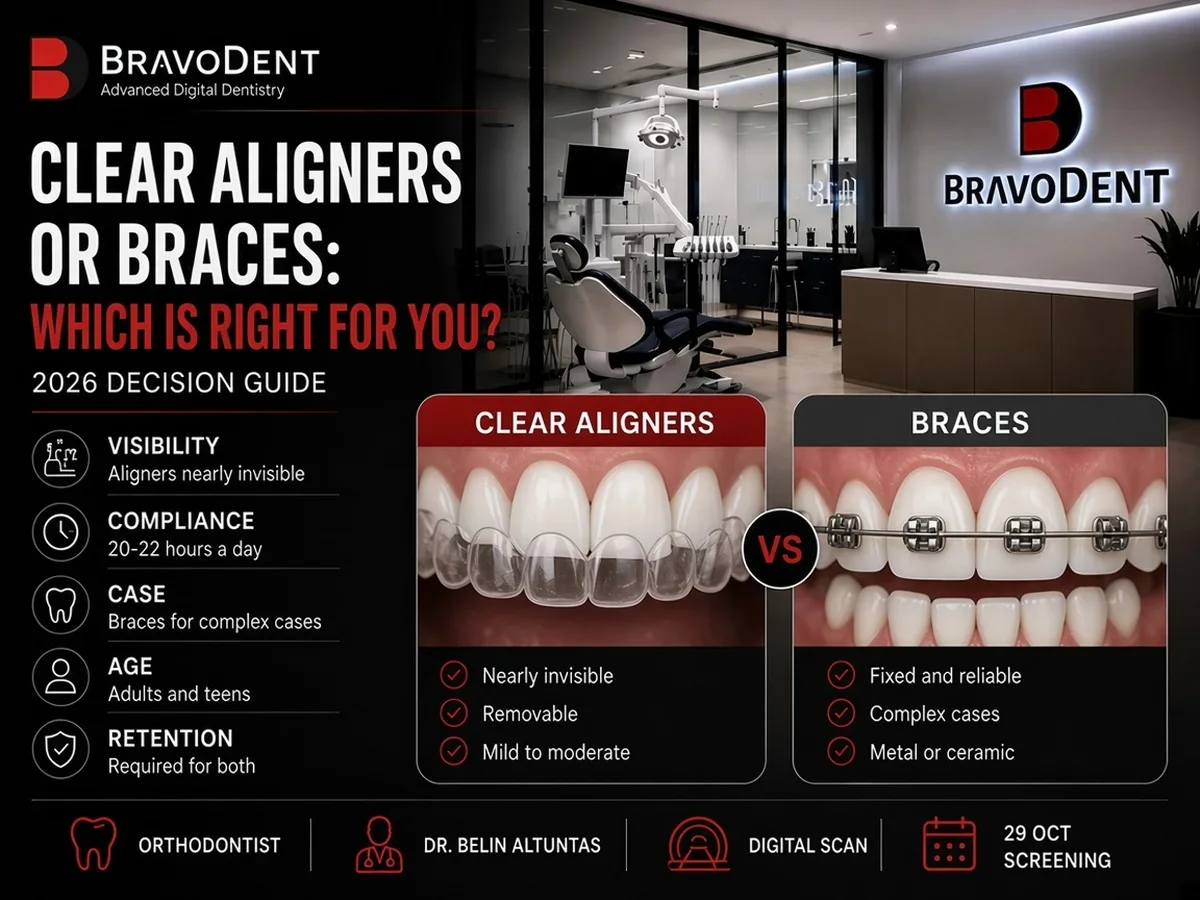
Bravodent Blog • Orthodontics
You have decided to straighten your teeth, but one question remains: clear aligners or braces? The short answer is this: both work; the right choice depends on your age, how complex your case is, and whether you can wear the aligners for 22 hours a day. This guide puts the two methods side by side and gives separate decision tables for adults and teens. The simplest way to see which one fits you is the free Orthodontic Screening Day at Bravodent Kadıköy on 29 October 2026.
|
🩺 Medically reviewed: Dr. Dt. Belin Altuntaş • Orthodontist |
|
⚡ Quick Guide
|
|
📅 29 October 2026 • Free Orthodontic Screening Day Invest in your smile on Republic Day. Our orthodontist examines your teeth in 3D with an I-Metric 4D digital scan and explains the same day whether clear aligners or braces are right for you. 10:00-19:00 • Kadıköy / Bostancı • No obligation. |
What Are Clear Aligners and Braces?
Clear aligners are a series of thin, transparent plastic trays made for your teeth. Each tray moves the teeth by one planned step, and you usually move to the next tray every 1 to 2 weeks. The trays come out for eating and brushing. The best-known brand is Invisalign; see our Invisalign page for details.
With braces, small brackets are bonded to the teeth and connected by a wire. The orthodontist adjusts the wire at review visits. Brackets are fixed; the patient cannot remove them. There are two main types by how visible they are:
- Metal brackets: The most common and the most durable option. They give the widest control in complex cases.
- Ceramic (tooth-coloured) brackets: Less noticeable; they are not as durable as metal.
Clear Aligners or Braces: The Main Differences
| Criterion | Clear aligners | Braces |
| Visibility | Almost invisible | Metal is obvious; ceramic brackets are less visible |
| Removable | Yes, for eating and brushing | No, they are fixed |
| What success depends on | Largely on wearing them 20-22 hours a day | Less dependent on patient compliance |
| Suitable cases | Mild and moderate cases, many bite problems | A wide range, from mild to complex |
| Eating | No restriction; the aligner comes out | Hard and sticky foods need care |
| Oral hygiene | Easier; normal brushing | Around the brackets, a special brush and floss |
| Comfort | Smooth edges; brief pressure with a new tray | Brackets can irritate the cheek; sensitivity after an adjustment |
| Review visits | Usually less often; digital follow-up is possible | Regular wire adjustments are needed |
| Loss or breakage | An aligner can be lost | A bracket can come off |
| After treatment | A retainer is essential | A retainer is essential |
Published research supports this table. A systematic review in BMC Oral Health reports that clear aligners are effective in mild and moderate cases, while braces give more predictable results for some complex tooth movements and for fine bite adjustment (Ke et al., 2019).
Decision Table for Adults
In adults, jaw growth is complete. The decision depends more on case difficulty, lifestyle and how the result should look. For the details of adult treatment, see our orthodontics for adults page.
| Your situation | The option that stands out | Why |
| A job with many meetings, presentations and client contact | Clear aligners | Almost invisible, and they do not clearly affect speech |
| Mild crowding or a gap between teeth | Clear aligners | Can be solved in a shorter time, with more comfort |
| Teeth shifted after earlier orthodontic treatment (relapse) | Usually clear aligners | Suitable for mild corrections |
| Severe crowding, an impacted tooth, closing a large space | Braces | More control for complex movements |
| You do not think you can wear aligners consistently | Braces | Success does not depend on patient compliance |
| Aligning teeth before an implant, bridge or veneer | Either, depending on the case | Decided together with the clinician’s plan |
| A history of gum disease | Gum treatment first, then the decision | Orthodontic movement needs healthy gums |
| Contact sports, wind instruments | Usually clear aligners | The aligner can come out; brackets carry an injury risk |
|
At Bravodent: A large share of our adult patients ask for clear aligners for appearance, but we always decide after a digital scan and a clinical exam. When needed, we plan orthodontics together with smile design, implants or gum treatment. |
Decision Table for Teens (Ages 12-17)
The teenage years are one of the most productive times for orthodontics: most permanent teeth have erupted, and growth is still going on. The biggest question at this age is discipline. If the aligner is left in a bag, treatment takes longer; braces keep working as long as they stay on.
| Situation | The option that stands out | Note for parents |
| The child can take responsibility, and appearance matters a lot to them | Clear aligners | Track daily wear time together |
| They tend to lose the aligner or forget to wear it | Braces | Because they are fixed, compliance is not the problem |
| A jaw mismatch that should be guided with growth | Braces or extra appliances, after a specialist assessment | Timing is critical; do not leave it late |
| Mild crowding, good oral hygiene | Clear aligners | Fits sport and school life |
| A canine that has not erupted, or an impacted canine | Usually braces | Needs regular X-ray follow-up |
| High sweets and snacks, weak brushing | Hygiene coaching first | Decay risk rises around brackets; sugary drinks are not worn with aligners |
The mistake parents make most often with teen patients is deciding on appearance alone. The orthodontist weighs the growth stage and the child’s habits together.
Younger Children: The First Orthodontic Check by Age 7
The American Association of Orthodontists (AAO) recommends that every child be assessed by an orthodontist by age 7 at the latest. Treatment is not always needed at that age. If a crossbite, a very narrow jaw or a thumb-sucking habit is spotted early, a simpler treatment may be possible later.
If your child has not met a dentist yet, start with a first visit in paediatric dentistry. If they are anxious before the check, the visit can be planned step by step. For school-age follow-up, the same paediatric exam covers the checklist. At Bravodent, the paediatric dentistry and children’s orthodontics teams work together; follow-up from the primary-tooth years through the teens stays in one clinic.
A note for children who play sport: Protruding front teeth are more likely to break in a fall or a blow. Children in orthodontic treatment who play sport should wear a mouthguard. If a permanent tooth is knocked out, hold it by the crown, keep it in milk, and reach a clinic within 30 to 60 minutes.
When Are Braces the Better Choice?
Clear aligner technology improves every year, and helpers such as attachments (small, tooth-coloured bumps bonded to the tooth) widen what it can do. Even so, braces give a more predictable result in some situations:
- Serious skeletal mismatches of the lower or upper jaw (in some cases together with surgery)
- Bringing impacted teeth into place, especially canines
- Closing large spaces after a tooth extraction
- Cases that need a marked rotation around the tooth’s axis, or a large root movement
- Situations where wearing an aligner 20-22 hours a day is not possible
In some cases the two methods can be planned together: the difficult movements are done in a short period with braces, and treatment is finished with clear aligners.
Daily Life: Eating, Cleaning, Speech and Sport
Eating and drinking
Clear aligners do not restrict food. Only water should be drunk while the aligner is in, and the teeth should be brushed and the aligner put back after a meal. With braces, hard foods (nuts, ice), sticky foods (caramel, gum) and foods bitten off in one piece can knock a bracket off.
Cleaning
Because aligners come out, brushing and flossing stay normal. With braces, an interdental brush and orthodontic floss are needed so plaque does not build around the brackets; otherwise white spots can form around them.
Speech
With both methods there can be a slight lisp for the first few days; most patients adapt quickly.
Sport and music
For contact sports, the aligner can come out and a mouthguard can go in. With braces, the brackets can injure the lip and cheek in a blow, so an orthodontic mouthguard is recommended.
Treatment Time and Retention
Time depends more on the case than on the method. Mild cases can finish in a few months, while complex cases can take more than 2 years. With clear aligners, digital planning shows an estimated time at the start; if the aligners are not worn enough, the time gets longer.
When treatment ends, the work is not over. Teeth tend to move back toward their old positions, so a retainer is used after both methods. That can be a thin wire bonded behind the teeth, or a clear tray worn at night. Your orthodontist sets how long it is worn.
What Affects the Cost
Turkish Ministry of Health rules mean we do not publish prices on this site. The main factors that affect cost are:
- How difficult the case is, and the estimated treatment time
- The method and brand chosen (metal or ceramic brackets; the clear aligner system)
- How many aligners are needed, and any extra refinement trays
- Gum treatment, fillings or extractions needed before orthodontics
- The retainer and the review visits
You can learn your own treatment plan and payment options the same day at the 29 October Screening Day.
29 October 2026: Bravodent Orthodontic Screening Day
The most accurate answer to “clear aligners or braces?” is inside your mouth. That is why, on 29 October 2026, Republic Day, we are holding a free Orthodontic Screening Day at Bravodent Kadıköy.
|
📅 29 October 2026 • Free Orthodontic Screening Day 🕘 10:00-19:00 • 📍 Bravodent Kadıköy / Bostancı
Completely free. There is no obligation. Places are limited. or call now: +90 546 112 07 24 |
Who should come? Adults bothered by crowded teeth, people whose teeth shifted after earlier braces, parents deciding for a teenage child, and children over 7 who have never had an orthodontic check.
Orthodontics in Kadıköy / Bostancı
Bravodent is on the Asian side of Istanbul, in Kadıköy / Bostancı, and is easy to reach from Maltepe, Kartal, Ataşehir and Ümraniye. The orthodontic department offers metal and ceramic brackets, clear aligners (Invisalign) and retention together. Service pages: orthodontics, clear aligners (Invisalign), orthodontics for adults. Clinician: Dr. Dt. Belin Altuntaş, Orthodontist.
Frequently Asked Questions
Are clear aligners better than braces?There is no single right answer. In mild and moderate cases the two methods give similar results. In complex cases braces are more predictable. If you cannot wear the aligner 20-22 hours a day, braces are the safer choice. |
Can clear aligners be used in every case?No. Serious skeletal problems, impacted teeth and closing large spaces may need braces or a combined plan. Suitability is decided with a digital scan and an exam. |
Are clear aligners suitable for my teenage child?They are suitable for teens whose permanent teeth have mostly erupted and who can wear the aligner regularly. If they tend to skip wear time, braces are safer. |
Which one finishes faster?Case difficulty decides the time more than the method does. In mild cases clear aligners can be shorter; if the aligners are not worn enough, treatment takes longer. |
Do clear aligners or braces hurt?With both, there can be mild pressure and sensitivity for 1-3 days after a new aligner or a wire adjustment. That is normal and usually passes on its own. |
Can adults have braces?Yes. If the gums and bone are healthy, orthodontic treatment has no upper age limit. Adults usually choose clear aligners or ceramic brackets for appearance. |
Do teeth move back after treatment?They can if a retainer is not worn. That is why a retainer is essential after both methods. |
At what age should my child see an orthodontist?The AAO recommends the first orthodontic assessment by age 7 at the latest. Finding a problem early can make a simpler treatment possible later. |
Is the 29 October Screening Day really free?Yes. On 29 October 2026 the digital scan and the suitability assessment at the Orthodontic Screening Day are completely free. Starting treatment is not required. |
Why This Content Is Trustworthy
|
Dr. Dt. Belin Altuntaş Orthodontist • Clear Aligners (Invisalign) • Adult and Children’s Orthodontics This article was medically reviewed and approved by Dr. Dt. Belin Altuntaş, a graduate of Yeditepe University Faculty of Dentistry who completed doctoral training in the Department of Orthodontics at Okan University. She provides clear aligners, brace treatment, and adult and children’s orthodontics at Bravodent Kadıköy. |
Sources
- Ke Y, Zhu Y, Zhu M. A comparison of treatment effectiveness between clear aligner and fixed appliance therapies. BMC Oral Health, 2019.
- Effectiveness of clear aligner therapy for orthodontic treatment: A systematic review (PubMed 31651082).
- Treatment Effectiveness of Clear Aligners in Correcting Complicated and Severe Malocclusion Cases Compared to Fixed Orthodontic Appliances: A Systematic Review (Healthcare, 2023).
- American Association of Orthodontists: Orthodontics for Children.
Bravodent | Kadıköy, Istanbul | Licensed by the Turkish Ministry of Health | 25 years of experience. This content is for information. Ask your dentist about your own dental health.