
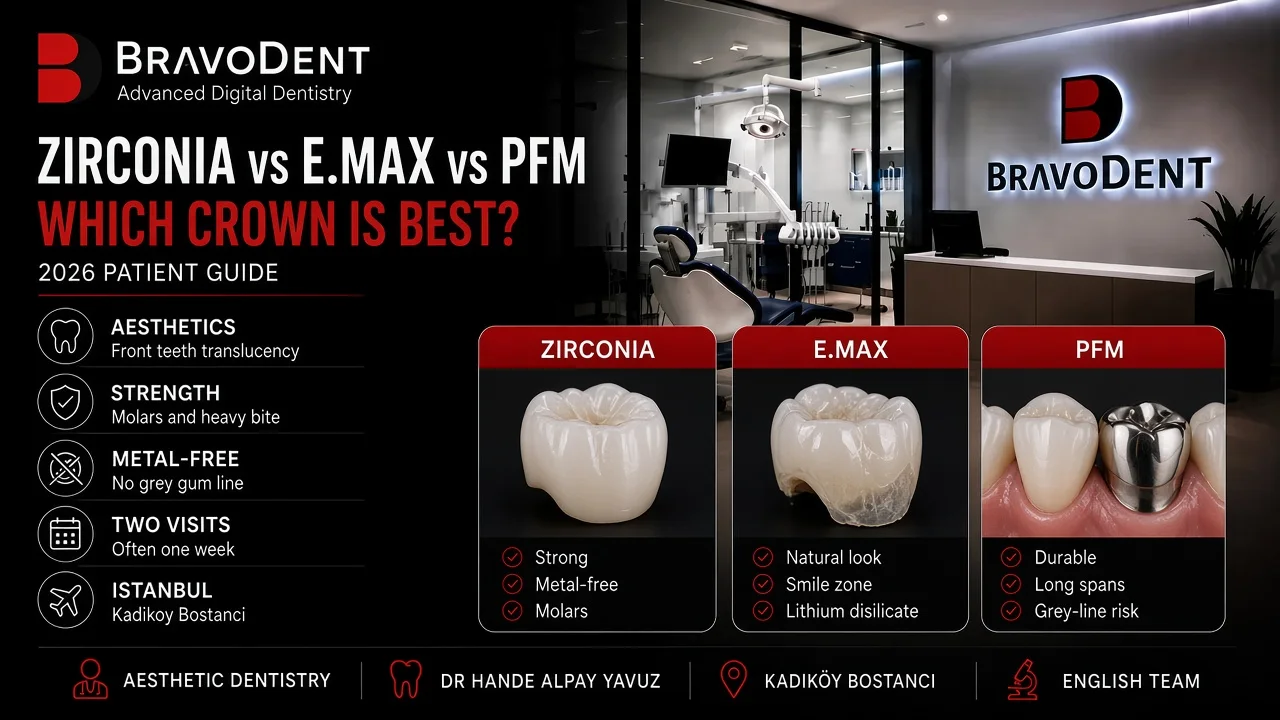
Bravodent Blog • Aesthetic Dentistry
There is no single best crown for every tooth. Zirconia, E.max (lithium disilicate) and porcelain-fused-to-metal (PFM) all cover a prepared tooth, but they differ in translucency, strength, gum-line appearance and how they behave under a heavy bite. Front teeth usually need light transmission. Molars and bruxism cases usually need toughness. This guide is for international patients planning treatment in Istanbul; it does not replace an exam or a shade try-in.
|
🩺 Medically reviewed: Dr. Hande Alpay Yavuz, DDS, PhD (Periodontist, Cosmetic Prosthodontist) |
|
⚡ Quick Guide
|
What Is a Dental Crown?
A crown is a custom cap that covers a tooth after the outer surface has been reduced. Dentists use crowns when a filling is no longer enough: a cracked cusp, a large old restoration, a tooth after root canal treatment, or a tooth that needs a new shape and colour. The American Dental Association (ADA MouthHealthy: Crowns) describes crowns as restorations that protect a damaged tooth and restore chewing. The UK National Health Service (NHS: Dental treatments) likewise positions a crown as a fitted cap, not a cosmetic sticker.
A veneer is thinner and usually stays on the visible face of a front tooth. If more than about half the tooth is already lost, a crown is the more honest restoration. Smile-zone planning often sits next to digital smile design and laminate veneers. Treatment page for lithium disilicate restorations: E.max dental crowns in Istanbul.
E.max Crowns (Lithium Disilicate)
E.max is a glass-ceramic (lithium disilicate). Light passes through it much like enamel, so incisors and canines often look more “alive” than opaque zirconia of the same shade. It bonds well to enamel when isolation is good. That combination is why many aesthetic cases in 2026 still start with E.max for the smile zone.
Limits matter. Lithium disilicate is strong enough for many single premolars, but it is not the first pick for a heavy grinder’s second molar or a long-span bridge. If you already know you clench at night, say so before the lab prescription. More detail on indications: E.max veneers: pros, cons and uses.
Zirconia Crowns
Zirconia is a high-strength ceramic with no metal core. Classic opaque zirconia was built for molars and implant abutments. Newer translucent (often called “aesthetic”) zirconia improved the front-tooth look, but it still usually transmits less light than E.max. The trade-off is toughness: zirconia copes better with grinding, implant screw channels and tight posterior contacts.
At Bravodent, zirconia is often planned for back teeth, implant crowns and patients with bruxism. A night guard after cementation is not a sales extra; it is how ceramic survives a parafunctional bite. Zirconium restorations: zirconium crowns in Istanbul.
Porcelain-Fused-to-Metal (PFM) Crowns
PFM has a metal coping with porcelain stacked on top. For decades it was the workhorse crown: strong framework, repairable in the lab, useful for long bridges. The porcelain can chip off the metal. If the gum recedes, a grey or dark line can appear at the margin. Light does not pass through the metal, so the tooth can look flatter next to an E.max neighbour.
PFM is not “obsolete.” It is simply less often first choice when the gum line is visible in photos and the case is a single front tooth. It still has a role when span length or remaining tooth structure needs a metal skeleton. The honest conversation is about the margin, not nostalgia for the material.
Zirconia vs E.max vs PFM: How to Choose
Choose by the tooth’s job, not by a ranking table on the internet. The same patient can have E.max on an incisor and zirconia on a first molar.
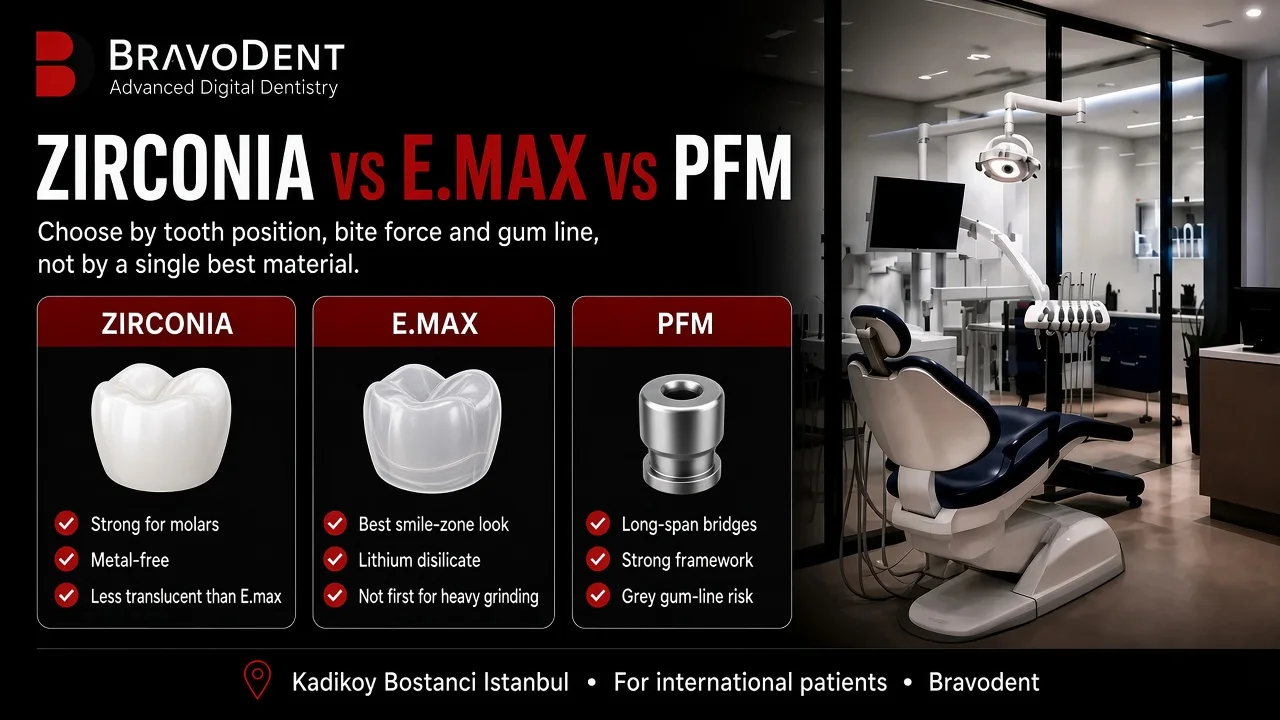
| Question | E.max | Zirconia | PFM |
| Best typical use | Front teeth, high-smile line | Molars, implants, grinders | Long-span bridges |
| Translucency | Highest of the three | Improved, still more opaque | Metal blocks light |
| Grey gum line | Unlikely if margin is healthy | Unlikely (metal-free) | Possible if gums recede |
| Heavy bite / bruxism | Use with caution | Usually preferred | Framework is strong; porcelain can chip |
| Metal allergy concern | No metal | No metal | Contains a metal coping |
| Bond vs cement | Often adhesively bonded | Often conventional cement | Conventional cement |
If a tooth is missing rather than damaged, a crown on neighbours is a bridge, not a single crown. Compare that path with implant vs bridge before reducing healthy enamel.
How Crown Treatment Works
International patients usually want a clear calendar. Most straightforward ceramic crowns at Bravodent Kadıköy / Bostancı are planned as two chairside visits with the lab working between them. Complex bite changes, many units, or active gum disease add days. The sequence below is typical, not a guarantee.
|
1 |
Exam, photos and X-raysWe check remaining tooth, gum health, contacts and whether a root canal or gum treatment must come first. Photos capture the high smile line that a mirror cannot. |
|
2 |
Shade and material prescriptionThe lab is told tooth number, ceramic type and how translucent the neighbour is. This is where E.max vs zirconia vs PFM is locked, not in a WhatsApp poll. |
|
3 |
Preparation under local anaestheticThe tooth is reduced to make space for ceramic thickness. Old fillings and decay are removed. Pain during the visit is not expected once the tooth is numb. |
|
4 |
Digital impression and temporary crownA 3D scan replaces trays for most cases. A temporary crown protects the tooth and the gum while the lab mills or layers the final piece. |
|
5 |
Try-in: colour, contact and biteWe check the shade in daylight-type light, floss contacts, and make sure the bite does not hit first on the new crown. A remake is better than cementing a mismatch. |
|
6 |
Cementation and home careThe crown is bonded or cemented, excess is cleaned, and you leave with floss and bite instructions. Avoid very hard foods on that side for 24 hours. Gum bleeding that lasts is a reason to message us, not to wait for the next holiday. |
How Long Do Crowns Last?
| Phase | What to expect |
| First 24 hours | Mild gum tenderness; bite may feel high until you adapt |
| First week | Floss daily at the margin; temporary sensitivity to cold can settle |
| Years, with care | About 10–15 years is a typical planning range for a well-maintained single crown; decay at the margin and grinding shorten that |
How long do crowns last? For a single tooth with healthy gums and a controlled bite, we usually plan about 10–15 years of service. That is a clinical range, not a personal warranty. A systematic review of tooth-supported single crowns estimated 5-year survival at 96.6% for lithium-disilicate (or leucite) glass-ceramic and 92.1% for densely sintered zirconia, close to metal-ceramic crowns; those zirconia figures still include older veneered designs that chip more than today’s monolithic crowns (Sailer et al., Dent Mater 2015, PubMed 25842099). A lithium-disilicate systematic review reported 97.8% cumulative survival at 5 years and 96.7% at 10 years for single crowns, with thinner evidence after year 10 (Pieger et al., J Prosthet Dent 2014, PubMed 24674802). Night grinding and decay at the edge fail more crowns than the ceramic name on the lab ticket.
Crowns vs Veneers
Veneers change the face of a mostly intact front tooth. Crowns wrap the tooth when walls are thin, cracked or already crowned. Mixing veneers on intact incisors with crowns on heavily restored canines is common in a smile makeover. See aesthetic dentistry for how those plans sit together.
Dental Crowns in Istanbul for International Patients
Bravodent is in Kadıköy / Bostancı, on Istanbul’s Asian side. Crown cases for travellers are coordinated in English: photos and X-rays before you fly, two clinical visits for most single or small groups of ceramics, and a written aftercare note before you leave. Same-week completion is common when gums are healthy and the prescription is clear; it is not promised for every mouth. Logistics, transfers and stay planning: dental tourism in Istanbul. Appointments: contact.
Frequently Asked Questions
Which is best: zirconia, E.max or PFM?None is best for every tooth. E.max often wins on visible front teeth. Zirconia often wins on molars and grinders. PFM still helps some long-span bridges. |
Is E.max strong enough for back teeth?Sometimes, on a calm bite and a single premolar. A second molar with heavy grinding is usually zirconia, not E.max. |
Do zirconia crowns look natural?Newer translucent zirconia is much better than early opaque blocks. Next to a highly translucent E.max incisor, a mismatch can still show. Shade try-in decides. |
Why can PFM show a dark line?The metal coping sits at the margin. If the gum thins or recedes, the grey edge becomes visible, especially on a high smile. |
How many visits do international patients need?Most small ceramic cases: two visits, often 5–7 days apart. Gum treatment, root canal or a large smile design adds time. |
Crown or veneer?Veneer if the tooth is mostly intact and only the face needs a change. Crown if walls are weak, cracked, or already heavily filled. |
Can I fly home the same day as cementation?Often yes after a simple single crown once the bite is comfortable. We prefer you stay until numbness has gone and you have eaten a light meal. |
How long do dental crowns last?About 10–15 years is a typical planning range for a well-maintained single crown. Reviews report ~96–98% 5-year survival for lithium-disilicate single crowns and high 10-year survival in limited data; grinding and margin decay shorten this. It is not a lifetime restoration. |
Will a crown stop me grinding?No. A crown restores the tooth; a night guard protects ceramic. Untreated bruxism chips porcelain and can crack zirconia too. |
Why This Content Is Trustworthy
|
Dr. Hande Alpay Yavuz, DDS, PhD Periodontology • Cosmetic prosthodontics • Smile design This article was written and medically reviewed by Dr. Hande Alpay Yavuz, who graduated with honours from Ondokuz Mayıs University Faculty of Dentistry in 2006 and completed her PhD in Periodontology at Istanbul University in 2014. She has more than 17 years of clinical experience in pink aesthetics, periodontal therapy and smile design, and has practised at Bravodent Kadıköy since 2023. Crown material is chosen with gum display and bite force in the same plan, not as a catalogue upgrade. |
|
Send photos, get a material plan before you fly Book an English-language crown consult at Bravodent Kadıköy / Bostancı, Istanbul. |
Sources: ADA MouthHealthy: Crowns; NHS: Dental treatments; Sailer et al., Dent Mater 2015 (PubMed 25842099); Pieger et al., J Prosthet Dent 2014 (PubMed 24674802).
This content is for information only. Diagnosis and material choice require a clinical examination.