
Bravodent Blog • Implantology
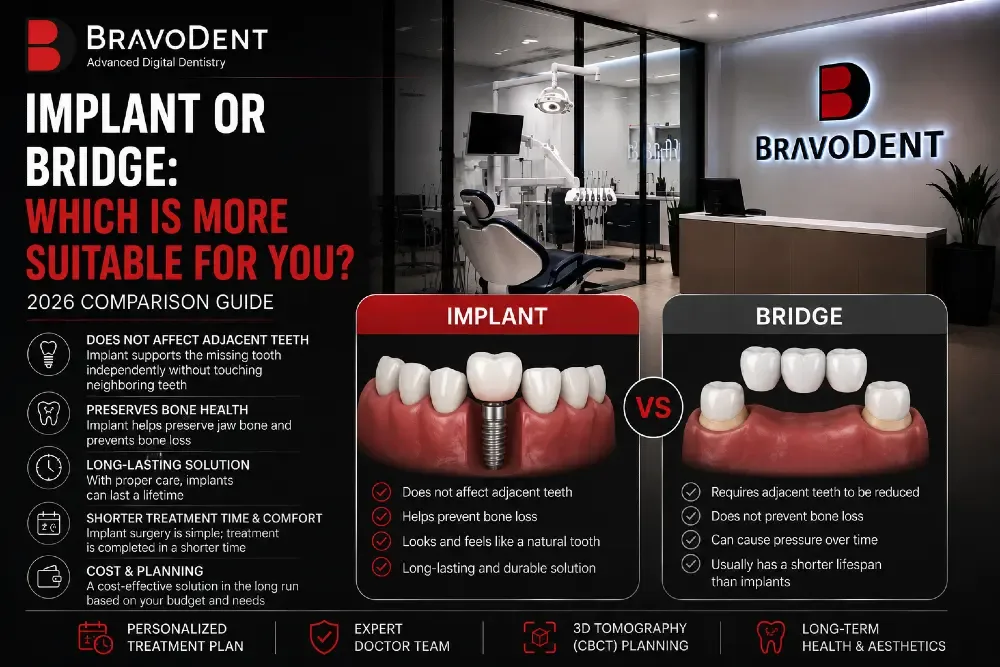
The main difference between an implant and a bridge is how the missing tooth is supported: a dental implant places a titanium root in the jawbone and a single crown on top, without touching neighbouring teeth; a dental bridge closes the gap by reducing the teeth on both sides and using them as abutments. If neighbouring teeth are healthy and bone is adequate, an implant is usually the first choice in 2026. A bridge is more suitable when bone is insufficient, surgery is not wanted, or the adjacent teeth already need crowns. There is no single “better” method for everyone.
|
🩺 Medically reviewed: Dr. Ümit Sait Yavuz (DDS, PhD) — Oral Surgeon, Implantologist, Periodontologist |
|
⚡ Quick Comparison
|
What Is a Dental Implant?
A dental implant is an artificial root — titanium or zirconia — placed in the jawbone in place of a missing tooth. An abutment and then a zirconia or E-max crown sit on top. The implant transfers load to the bone like a natural tooth root, so bone loss under the gap slows or stops. With a single-tooth implant, the teeth on either side are not reduced.
Osseointegration (fusion of the implant with bone) usually takes 2–6 months. In suitable cases a same-day temporary tooth can be fitted; the permanent crown is placed after fusion. Treatment page: dental implants in Istanbul.
What Is a Dental Bridge?
A conventional dental bridge closes a gap by reducing the teeth on both sides (abutment teeth) and cementing a fixed prosthesis to them. The middle unit (pontic) fills the space; no root is placed in the bone. For a single missing tooth the most common design is a 3-unit bridge: two abutments + one pontic.
A bridge does not require surgery. With impressions, try-in and cementation, most cases finish in 1–2 weeks. The drawback is irreversible: healthy enamel and dentine are reduced. Because there is no root under the pontic, bone shrinkage in that area can continue. If one abutment tooth decays or fractures, the whole bridge is affected.
Implant vs Bridge: Key Differences
Both methods replace a missing tooth with a fixed restoration. The difference is in neighbouring teeth, bone protection, time, surgery and long-term cost:
| Criterion | Dental Implant | Dental Bridge |
| Effect on neighbouring teeth | Untouched | Two adjacent teeth are reduced (irreversible) |
| Bone protection | Transfers load, slows bone loss | Bone loss under the pontic can continue |
| Typical lifespan | 15–25+ years with care | 7–15 years; replacement may be needed |
| Treatment time | 2–6 months (same-day temporary tooth in suitable cases) | 1–2 weeks |
| Surgery | Yes (local anaesthesia / sedation if needed) | None |
| Upfront cost | Higher | Lower |
| Long-term cost | Usually more economical | Can rise with replacement and abutment-tooth treatment |
| Cleaning | Like a natural tooth | Needs special cleaning under the pontic |
| If something fails | Affects a single unit | A problem in one abutment affects the whole bridge |
| Aesthetics | Very high (single tooth, gum line) | Good; pontic–gum junction is critical |
| Typical patient | Healthy neighbouring teeth + adequate bone | Adjacent teeth already need crowns / surgery not wanted |
Which Should You Choose: A Short Decision Guide
The decision is not “pick the more modern option”. It is which protocol matches your neighbouring teeth and your bone:
|
An implant may be more suitable if:
A bridge may be more suitable if:
|
If several teeth are missing, the options change: a bridge on two implants, separate implants, or a full-arch All-on-4 vs All-on-6 protocol. With advanced bone loss in the upper jaw, a zygomatic implant may also be considered. “One missing tooth = must have a bridge” is not the 2026 rule.
Who Implants and Bridges Are For
For a single tooth or a short gap, both methods restore function and aesthetics. Typical candidates:
- Patients missing one tooth with healthy neighbouring teeth (priority: implant)
- Short gaps where adjacent teeth already need crowns (a bridge can be rational)
- Patients who do not want a removable denture and want fixed teeth
- Patients who want to protect chewing, speech and the smile line
- Patients who will keep up hygiene and regular reviews after treatment
Uncontrolled diabetes, active gum infection, heavy smoking or insufficient bone can change or delay an implant plan. For a bridge, the periodontal health and root-canal status of the abutment teeth are critical. Placing a bridge on decayed or infected abutments is a short-lived solution. The final decision is made only after examination and imaging.
Treatment Process
Both paths start with the same examination. They diverge after CBCT and assessment of the neighbouring teeth.
|
1 |
Examination and 3D planningClinical exam, panoramic imaging and, when needed, CBCT assess bone volume, the sinus, the nerve canal and the bite. Decay, fillings and root-canal status of neighbouring teeth are also checked. The implant vs bridge decision is clarified at this stage. |
|
2 |
Implant path: surgeryThe implant is placed in bone under local anaesthesia. If primary stability is enough, a same-day temporary tooth can be fitted. Otherwise a healing cap is used and osseointegration is awaited for 2–6 months. |
|
3 |
Bridge path: preparation and try-inAbutment teeth are reduced, a digital or conventional impression is taken, and a temporary bridge is fitted. The laboratory makes a zirconia or porcelain bridge; it is cemented after try-in. Time in most cases is 1–2 weeks. |
|
4 |
Permanent tooth and follow-upOn the implant path the permanent crown is fitted after fusion. On the bridge path treatment ends on cementation day. For both, six-monthly reviews, a night guard when needed and interdental cleaning determine how long the work lasts. |
One Tooth, Several Teeth and a Full Arch
One missing tooth: If neighbouring teeth are healthy, a single-tooth implant is the gold standard. A bridge unnecessarily sacrifices two sound teeth.
Two–three missing teeth: Options include two implants plus an implant-supported bridge, a separate implant for each space, or a long conventional bridge. Reducing more abutment teeth is riskier in the long term.
A fully edentulous jaw: A conventional bridge is not the solution here. The fixed options are All-on-4 or All-on-6; a removable denture is a separate discussion. Comparison: All-on-4 and All-on-6 implant treatment.
What Affects the Cost
The first invoice for an implant is higher than for a bridge: surgery, implant brand and crown are separate items. A bridge is produced as three units (two abutments + pontic) in one go, so the upfront figure looks lower. Over 10–15 years, bridge replacement plus abutment decay or root-canal treatment often closes the gap; in most cases the implant becomes more economical.
- Number of missing teeth and length of the gap
- Implant brand and crown / bridge material (zirconia, E-max)
- Need for extraction, grafting or sinus lifting
- Root-canal or crown need on abutment teeth
- Sedation preference and follow-up protocol
|
The situation at Bravodent: After the first examination and imaging, we share a personalised treatment plan and itemised cost breakdown. We do not push a ready-made package in order to “sell an implant” or “sell a bridge”. See also our dental implants page. |
Longevity, Care and Success
With correct case selection and regular care, implants last 15–25 years, and often longer. The crown surface can wear and be renewed; the fixture remains as long as it stays integrated in bone. A bridge typically lasts 7–15 years. Abutment decay, gum recession or poor cleaning under the pontic shorten that. For both, a night guard (if you grind), interdental brushes / superfloss and six-monthly reviews are essential. An implant is not “lifetime without care”; neglected peri-implant gum inflammation can lead to loss.
|
The situation at Bravodent: We do not say “implant is better” or “a bridge is enough” until we see the real state of neighbouring teeth and the 3D volume of your bone. A realistic lifespan and protocol for your case is discussed after tomography. |
Implant and Bridge Planning at Bravodent
At Bravodent Kadıköy / Bostancı, missing-tooth planning is done with a team experienced in periodontology, implantology and oral surgery, using CBCT and digital impressions. Under clinical oversight, Dr. Ümit Sait Yavuz is actively involved in single-tooth implants, implant-supported prostheses, All-on-4 / All-on-6 and zygomatic cases. The aim is not to reduce healthy teeth, and to choose the protocol that fits the bone. Patients travelling from Europe included, we offer a transparent treatment plan and a free first assessment.
Frequently Asked Questions
Is an implant or a bridge better?There is no universally better method. If neighbouring teeth are healthy and bone is adequate, an implant is usually the first choice in 2026, because healthy teeth are preserved and bone continues to take load. If adjacent teeth already need crowns, bone is insufficient or surgery is not wanted, a bridge can be the right choice. The decision is made after examination and CBCT. |
What is the difference between an implant and a bridge?An implant places a root for the missing tooth in the bone; neighbouring teeth are not touched. A bridge reduces the teeth on both sides of the gap and closes it with a fixed prosthesis attached to them. An implant protects bone; bone loss can continue under a bridge pontic. |
For one missing tooth, implant or bridge?For a single missing tooth and healthy neighbours, an implant is the gold standard. A bridge irreversibly reduces two sound teeth. If those teeth already need large restorations or crowns, a bridge can be more rational. |
Does an implant last longer than a bridge?With care, implants can last 15–25 years and beyond. Bridges are usually replaced after 7–15 years. Durability depends on bone quality, abutment-tooth health, prosthesis material and hygiene. |
Is an implant or a bridge cheaper?Upfront, a bridge is usually cheaper. Over 10–15 years, bridge replacement and abutment-tooth treatment often make the implant more economical. The exact difference depends on brand, material, grafting and how many teeth are involved. At Bravodent the price is personalised after imaging. |
Does a bridge damage the teeth?Abutment teeth are reduced for a bridge; that is irreversible. In the right case it is not a problem. In the wrong case (sound teeth with small fillings) it means unnecessary tooth loss and a higher later risk of decay or root-canal treatment. |
What if there is not enough bone for an implant?Grafting, a short implant or angled placement is considered first. If a graft is not wanted or surgery is not suitable, a bridge is a practical alternative. With advanced upper-jaw loss, a zygomatic implant protocol may be discussed. “No bone” does not by itself mean treatment is impossible. |
Is an implant painful, and is it harder than a bridge?An implant is placed under local anaesthesia and, if needed, sedation; no pain is felt during surgery. Swelling afterwards usually settles in 1–2 days. A bridge involves no surgery; there can be sensitivity during abutment preparation and the temporary phase. “Difficulty” depends on the person and the anatomy. |
Can an implant or a bridge be done for everyone?No. An implant needs adequate bone, suitable general health and compliance with aftercare. A bridge needs sound or restorable abutment teeth. Active infection, uncontrolled systemic disease or advanced bone loss changes the plan. Suitability is determined by examination and 3D imaging. |
Why This Content Is Reliable
|
Dr. Ümit Sait Yavuz (DDS, PhD) Oral Surgeon • Implantologist • Periodontologist This article has been medically reviewed and approved by Dr. Ümit Sait Yavuz, a specialist in oral surgery, implantology and periodontology at Bravodent. Dr. Yavuz is actively involved in single-tooth implants, implant-supported prostheses, All-on-4, All-on-6 and zygomatic implant cases. |
|
Let your teeth and bone decide implant vs bridge Plan a free first examination at Bravodent Kadıköy for a detailed tomography assessment and specialist opinion. |
This content is for information only. We recommend visiting our clinic for a personal assessment.