
|
Bravodent Blog • Teeth Whitening Guide |
||||||
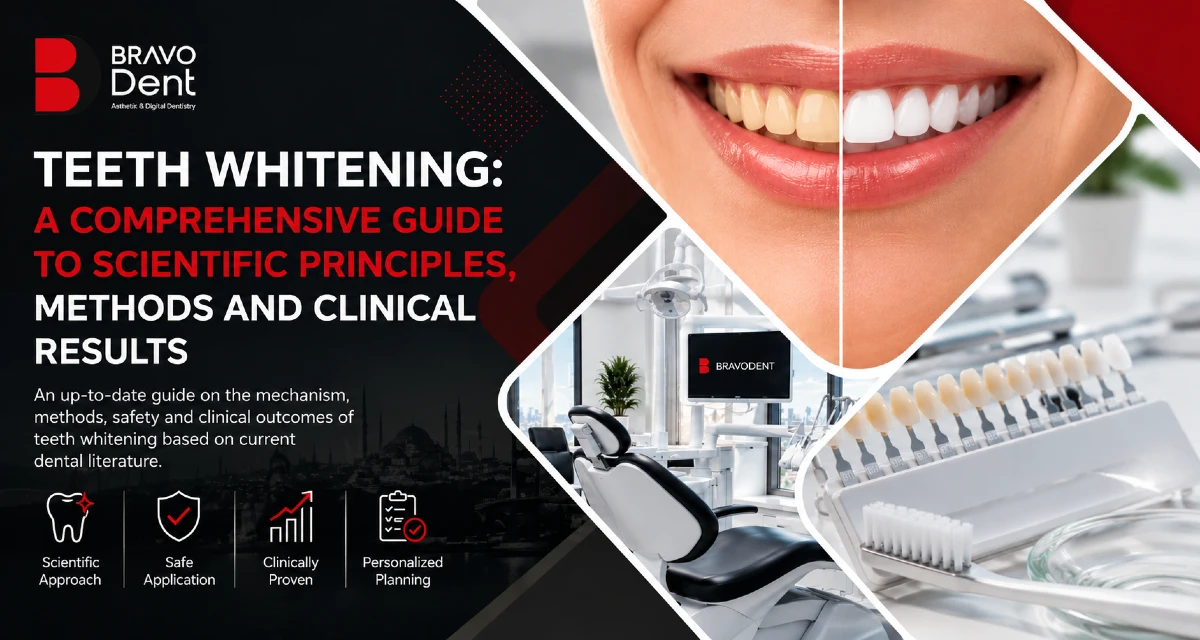
Teeth Whitening: A Scientific Guide to Its Mechanisms, Methods and Clinical Outcomes |
||||||
|
||||||
|
Tooth colour change is one of the most requested topics in cosmetic dentistry, and it remains an area of active investigation in dental literature. This review-style guide covers the clinical classification of tooth discolouration, the mechanism of action of whitening agents, the methods available, expected outcomes, and safety profile — based on current dental literature and presented alongside Bravodent's clinical approach. |
||||||
1. Classification of Tooth Discolouration |
||||||
|
Dental literature classifies discolouration into two main categories. Extrinsic pigmentation is staining that builds up on the outer surface of the tooth, caused by tea, coffee, red wine, tobacco and inadequate oral hygiene, which accumulate on the pellicle layer. This type of staining generally responds predictably to professional cleaning and whitening. Intrinsic pigmentation is a colour change that occurs within the tooth structure itself, at the enamel or dentin level. Age-related dentin thickening and enamel thinning, use of tetracycline-class antibiotics during tooth development, excessive fluorosis, and post-trauma pulp changes all fall into this category. Response to whitening is more variable with intrinsic pigmentation; in severe cases such as heavy tetracycline staining, whitening alone may not be sufficient, and restorative options such as laminate veneers or crowns may be considered. |
||||||
2. Mechanism of Action of Whitening Agents |
||||||
|
Peroxide-based agents (hydrogen peroxide and carbamide peroxide) work through an oxidation reaction. When carbamide peroxide comes into contact with water in the oral environment, roughly a third of it breaks down into hydrogen peroxide and the rest into urea; this allows hydrogen peroxide to be released at a lower concentration but over a longer period — the basis for the low-dose/long-contact principle used in at-home whitening. Hydrogen peroxide diffuses into enamel and dentin, generating free radicals and reactive oxygen species. These molecules are thought to break down the double bonds in the organic pigment structures (chromophores) responsible for tooth colour, converting them into compounds that absorb less light and are therefore perceived as lighter. An important point worth emphasising in the literature is that the exact molecular mechanism of whitening has not yet been conclusively established; several hypotheses — chromophore breakdown, increased solubility, and changes in surface light reflection — are discussed together. |
||||||
3. Clinical Assessment and Shade Measurement |
||||||
|
In professional practice, tooth shade is recorded objectively before and after treatment using the standard VITA shade guide or spectrophotometric/colorimetric measurement methods. This allows both realistic management of patient expectations and objective documentation of the clinical outcome. |
||||||
4. Teeth Whitening Methods |
||||||
4.1 In-Office Professional WhiteningCarried out in a single session under dentist supervision, using a high-concentration hydrogen peroxide or carbamide peroxide gel. The gums are isolated with a protective barrier beforehand. Because concentration and application time are fully controlled by the dentist, this method delivers the fastest and most predictable result. |
||||||
4.2 Dentist-Supervised At-Home WhiteningCustom trays made from an impression of the patient's mouth are used at home with a lower-concentration carbamide peroxide gel for a set time each day. Results appear more gradually than with the in-office method; in return, keeping contact time and concentration lower can be an advantage in limiting sensitivity. |
||||||
4.3 Light/Laser-Assisted ActivationA variant of the in-office method in which gel activation is supported by LED light or laser. The literature is not fully in agreement on whether light activation adds meaningful whitening benefit: some studies suggest light support speeds up the result, while other reviews highlight that the whitening agent itself is the determining factor, and that the heat generated by the light may increase temporary sensitivity. |
||||||
5. Clinical Procedure Steps |
||||||
|
The clinical process generally follows these steps: assessment of periodontal and enamel health, professional scaling beforehand if needed, isolation of the gums with a protective barrier, application and activation of the whitening agent, application of desensitising agents containing fluoride or potassium nitrate afterward, and communicating aftercare guidance to the patient. |
||||||
6. Factors Affecting How Long Results Last |
||||||
|
How long whitening results last depends on the type and intensity of the original pigmentation, dietary habits (tea, coffee, red wine consumption), tobacco use, oral hygiene level, and periodic maintenance treatments. On average, results are reported to last 1-3 years, and regular maintenance can extend this period. |
||||||
7. Safety Profile and Possible Side Effects |
||||||
|
Professional whitening, applied by a dentist at an appropriate concentration and duration, is considered safe according to current dental guidelines. The most commonly reported side effect is temporary tooth sensitivity, which resolves on its own within a few days; this is explained by the hydrodynamic theory, in which peroxide passing through dentin tubules triggers fluid movement within the tubules that stimulates pulpal nerve endings. Prolonged, repeated use of uncontrolled, over-the-counter, high-concentration products, on the other hand, may increase the risk of enamel microhardness changes and gum irritation — which is why whitening should be planned under dentist supervision. |
||||||
8. Contraindications and Precautions |
||||||
|
Whitening is generally not recommended during pregnancy and breastfeeding, in the presence of active gum disease or untreated decay, in cases of severe tooth sensitivity, and generally for individuals under 16. Crowns, veneers and composite fillings do not respond to whitening agents, so colour matching should be assessed separately for patients with existing restorations, and restoration replacement options discussed if needed. In cases of severe intrinsic pigmentation (such as heavy tetracycline staining), the possibility of a limited response to whitening should be discussed with the patient beforehand. Final suitability is always determined through an individual clinical examination. |
||||||
9. Bravodent's Clinical Approach |
||||||
|
At Bravodent, periodontal health and enamel integrity are assessed before whitening, existing restorations (crowns/fillings) are reviewed for colour match, and the most suitable method (in-office, at-home, or a combined protocol) is agreed with the patient together. Post-treatment sensitivity management and a maintenance plan are offered as an integral part of the treatment programme. |
||||||
10. Frequently Asked Questions |
||||||
|
||||||
|
This content has been prepared based on current dental literature and clinical guidelines, and reviewed for medical accuracy by Bravodent's periodontist. |
||||||
|
Related Treatments → Dental Implants in Istanbul: Treatment and Recovery |
||||||
|