
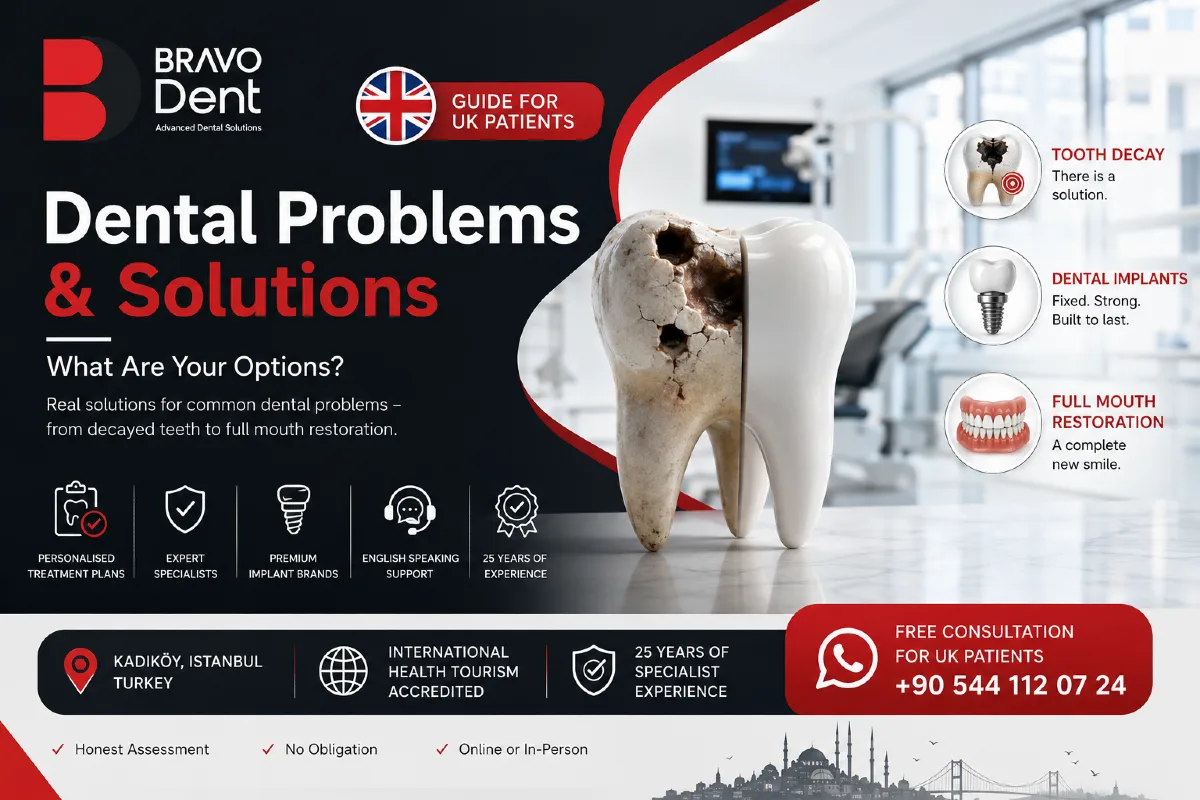
If you’ve landed here, you’re probably dealing with something you’ve been putting off for a while. Maybe your teeth have been getting worse for years. Maybe you’ve lost confidence in your smile. Maybe eating has become genuinely difficult.
You’re not alone — and you’re not out of options.
This guide is for people who know something needs to be done but aren’t sure where to start, what to ask, or what’s even possible. We’ll go through the most common situations and the realistic solutions available today — including options that might be more accessible than you think.
| No judgement here. Dental problems affect millions of people in the UK for all kinds of reasons — cost, fear, time, or simply life getting in the way. What matters is what you do next. |
| “My Teeth Are Rotting / Decayed — What Can Be Done?” |
Decay (dental caries) is the most common dental problem in the world. When caught early, fillings and root canal treatment can often save the tooth. When decay has progressed significantly, extractions followed by replacement are usually the next step.
Your options after decay-related tooth loss depend on how many teeth are affected:
- One or a few teeth: dental implants (single or multiple) or a bridge
- A significant portion of your mouth: implant-supported partial or full arch
- Most or all teeth: full-arch solutions like All-on-4 or All-on-6
| “I’ve Just Got Roots Left — What Happens Now?” |
If tooth decay has progressed to the point where only roots remain, extraction is usually unavoidable. But what happens after is very much in your control.
Once the roots are extracted, the bone needs time to heal — typically a few weeks to a few months. After that, you can proceed with implant placement. In some cases, immediate implant placement (same day as extraction) is possible, though this depends on bone condition.
| ℹ Key point: Having only roots left doesn’t automatically mean dentures. Modern implant techniques can still give you fixed, permanent teeth — it just requires the right assessment first. |
| “What’s the Alternative to Dentures?” |
If you’ve had dentures — or been told you’ll need them — you may already know their limitations: movement when eating, adhesives, removing them at night, the feeling that they’re never quite right.
The main alternative is implant-supported teeth. These are fixed permanently to titanium posts in your jaw. They don’t move. You don’t remove them. You brush them just like natural teeth.
| Dentures | Dental Implants | |
| Fixed in mouth? | No — removable | Yes — permanent |
| Bone preservation | No — bone loss continues | Yes — bone is stimulated |
| Eating comfort | Limited | Normal |
| Maintenance | Daily removal & cleaning | Brush like natural teeth |
| Lifespan | 5–8 years typical | 15–25+ years |
| Initial cost | Lower | Higher — but long-term value |
| “Should I Get Implants? Am I a Candidate?” |
Most adults are suitable for dental implants. The main factors your dentist will assess are:
- Bone density and volume in the jaw (visible on a 3D scan)
- Gum health — any active gum disease needs to be treated first
- General health — conditions like uncontrolled diabetes can affect healing
Even patients who’ve been told they “don’t have enough bone” may still be candidates. Bone grafting and sinus lift procedures can build up the bone where needed.
| ℹ The only way to know for certain is a proper clinical assessment — ideally including a 3D CT scan. At Bravodent, this assessment is free for new patients. |
| What Does Full Mouth Restoration Actually Look Like? |
If most or all of your teeth need to be replaced, the most common solution today is a full-arch fixed implant bridge — known as All-on-4 or All-on-6 depending on how many implants are used. Here’s what the process typically looks like:
| 1. Consultation & Scan |
A specialist reviews your dental history and takes a 3D scan to assess bone levels and plan treatment.
| 2. Extractions (if needed) |
Any remaining failing teeth are removed. In many cases this is done on the same day as implant placement.
| 3. Implant Surgery |
Titanium posts are placed in the jaw under local anaesthetic. Temporary teeth are usually fitted the same day.
| 4. Healing Phase |
The implants bond with the jawbone over 3–4 months. During this time, temporary teeth allow normal eating and speaking.
| 5. Final Teeth Fitted |
Your permanent, custom-made bridge is fitted. These are the teeth you’ll have for years to come.
| The Cost Question: Why Do Patients Travel Abroad? |
Full-arch implant treatment in the UK can cost £15,000–£30,000 or more. For many people, that cost puts it out of reach entirely — which is why some spend years struggling with failing teeth, waiting for a solution that never feels affordable.
That’s why a growing number of UK patients are travelling to Istanbul for treatment. Not because quality is lower — but because costs are significantly less, due to lower overheads, not lower standards.
At Bravodent Kadıköy, we use the same European-certified implant systems you’d find at a top UK clinic, delivered by specialist surgeons with decades of experience. The difference is what you pay — not what you receive.
| Where Do I Start If I Don’t Know What I Need? |
Start with a free consultation. That’s genuinely the answer — not a sales pitch.
Until a specialist has looked at your scans, no one can tell you exactly what treatment you need, what it will cost, or how long it will take. But that conversation is the thing that turns an overwhelming problem into a clear plan.
| At Bravodent, we offer free online consultations for UK patients. Send us your existing scans (or visit in person for a complimentary examination), and we’ll give you an honest assessment of your options — with no commitment required. |
| Real Questions We Get Asked (And Honest Answers) |
| “Will it hurt?” |
Implant surgery is performed under local anaesthetic — you won’t feel pain during the procedure. Discomfort in the days after is normal and manageable with standard over-the-counter pain relief. Most patients are surprised by how straightforward the recovery is.
| “How long will it take?” |
The full process (from implant placement to permanent teeth) takes 3–6 months. However, you’ll have functional temporary teeth from day one — so you’re not walking around toothless while you wait.
| “Is it too late for me?” |
In most cases, no. People in their 60s, 70s, and beyond undergo successful implant treatment regularly. Age alone is rarely a disqualifying factor. What matters most is bone health and general medical condition — and these can be assessed at your consultation.
| “What if I’m nervous about dentists?” |
You’re not unusual — dental anxiety affects a huge number of people, often including those who’ve let problems develop because of it. We have extensive experience with anxious patients. We work slowly, explain everything, and sedation is available for those who need it.
| Take the First Step — It’s Free |
|
📞 Call or WhatsApp us: +90 544 112 07 24 🌐 bravodent.com | Kadıköy, Istanbul 🦷 Free consultation for UK patients — online or in person |
You don’t have to keep putting this off. The first conversation is free, and it might be the one that finally gives you a clear path forward.
Bravodent | Kadıköy, Istanbul | 25 Years of Specialist Experience | International Health Tourism Accredited
This content is for informational purposes only. For a personal dental assessment, please book a consultation.